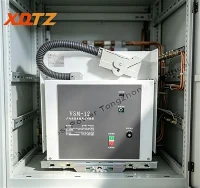

A voltage transformer (PT) is a special type of transformer whose main function is to convert high-voltage systems into low-voltage signals to facilitate the safe operation of protection, measurement, and control equipment. In power systems, due to operational and safety reasons, high-voltage lines are typically not directly measured; therefore, voltage transformers are used to reduce the voltage.
The secondary voltage of a voltage transformer is fixed at 100 volts, primarily for the following reasons:

Standardization
Establishing a standard secondary voltage simplifies the design and manufacturing process and facilitates the design and calibration of instruments and relays. All voltage transformer-based devices can be expected to have the same input voltage, eliminating the need for special adjustments for transformers of different voltage levels.
Safety
100 volts is a relatively low voltage level, significantly reducing the risk of electric shock to personnel and equipment, even in fault conditions, thus improving field safety.

Instrument Transformer Design
Based on the principle of electromagnetic induction, the secondary voltage of an instrument transformer is proportional to the primary voltage and independent of the secondary load resistance. By selecting an appropriate winding ratio, a secondary voltage of approximately 100 volts can be ensured in various practical applications while maintaining sufficient power transmission to the measuring equipment.
Measurement Accuracy
At low voltages, instruments and relays are more accurate because they are less sensitive to the effects of temperature, aging, and other environmental factors.

Economy
A fixed secondary voltage reduces the types of instrument transformers, simplifies inventory management, and also lowers production costs.
As for the working principle of JDZW-35 Voltage Transformer, it follows Faraday's law of electromagnetic induction. When the primary coil is connected to an AC power source, an alternating magnetic field is generated inside it. This magnetic field passes through the secondary coil, causing it to generate an electromotive force (EMF). The magnitude of the EMF is determined by the following formula:
[ E_2 = N_2 ∫_0^2 dPhi}{dt} ]
Where:
• ( E_2 ) is the secondary voltage.
• ( N_2 ) is the number of turns in the secondary coil.
• ( ∫_0^2 dPhi}{dt} ) is the rate of change of magnetic flux, which is related to the primary voltage and the number of turns ( N_1) of the primary coil.
Based on the turns ratio ((N_1):(N_2)) of the primary and secondary sides of the voltage transformer, we can calculate the secondary voltage (E_2). For example, if the primary side is 10kV and the secondary side is 100V, then we can set the relationship between (N_1) and (N_2) such that (\frac{N_1}{N_2} = \frac{10000}{100} = 100), so that at the same frequency, the secondary side will receive a voltage of 100 volts.
However, in practical applications, we do not always strictly guarantee that the secondary voltage is constant at 100 volts. Other specifications are also available, such as 57.7 volts (for phase voltage measurement in three-phase systems) or 100/3 volts (for line voltage measurement in three-phase systems). These different ratings are to accommodate the needs of different voltage levels and application scenarios.

more than 20 years of experience in Electrical industry
1. 12KV/24KV/40.5KV vacuum circuit breakers.
2. operating mechanism,chassis,main shaft.
3. insulation parts,contact box.
4. other accessories of vacuum circuit breaker and panels, such as tulip contact, movable contact, contact arm, flexible connectors etc.
Shaanxi West Power Tongzhong Electrical Co., Ltd.
Our address
No.1 East Gaoxin Avenue, High-tech Development Zone, Baoji City, Shaanxi Province, China
Phone Number
+86 18091767067(WhatsApp/Wechat/Telegram)