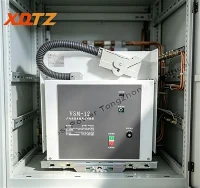

I. Key Points for Long-Term Lifespan of Spring-Mechanism VCB

Spring Operating Mechanism
The spring mechanism stores energy through mechanical springs (compression or torsion springs) and releases this energy via a complex system of links, gears, and cams to drive the circuit breaker's opening and closing.
1. Core Maintenance Focus: Precision Maintenance of the Mechanical System
Regular Lubrication: Strictly follow the manufacturer's requirements, using specialized low-temperature grease (such as Molykote or equivalent) on critical friction parts such as transmission links, bearings, gears, and slide rails. For high or low temperature environments, select products with appropriate weather resistance.
Bolt Tightness Inspection: Vibration can easily lead to loosening of mechanical connections. Regularly check and tighten all mechanism bolts to the standard torque, especially chassis connections and mechanism fixing points.
Spring Fatigue Monitoring: Closing springs are prone to fatigue or plastic deformation after frequent operation. It is recommended to regularly perform spring travel or pressure tests, compare with factory data, and replace promptly if deviations exceed limits.
Closing and Opening Buffer Inspection: Aging, leaking, or cracked hydraulic or polyurethane buffers can lead to excessive mechanical impact and damage to components. 1. Ensure adequate buffering effect, without rebound or rigid impact.
2. Key Parameter Monitoring and Adjustment
Closing and Opening Speed and Time: Measure regularly using a circuit breaker tester. Too slow a speed will prolong the arcing time, burning the contacts; too fast a speed will cause excessive impact, shortening mechanical life. Adjust strictly according to the technical range.
Stroke and Overtravel Measurement: Insufficient contact overtravel will lead to insufficient contact pressure, increased resistance, and overheating; excessive overtravel will increase the spring load. Measure regularly and adjust to standard values.
Mechanical Characteristic Curve Analysis: Plot a "stroke-time" curve using a tachometer and compare it with a standard curve. Abnormal curve shapes are often early signs of jamming, poor lubrication, or component wear.
3. Environmental and Operational Adaptability Optimization
Dust and Moisture Prevention: The mechanism box sealing strip must be intact to prevent dust accumulation leading to jamming and moisture causing corrosion. Consider installing an anti-condensation heater.
Operation Frequency Management: Avoid unnecessary frequent operations (such as repeated opening and closing during commissioning).
For applications with extremely frequent operation (such as metallurgy and steel rolling), the maintenance cycle should be shortened accordingly.
Energy Storage Motor Maintenance: Check the motor carbon brushes and gearbox to ensure normal energy storage time. Stop operation immediately after energy storage is complete to prevent motor overload.
II. Key Points for Long-Term Lifespan of Permanent Magnet vCB
Permanent Magnet Mechanism VCB
Key Points for Longevity of Permanent Magnet Vacuum Circuit Breakers Permanent magnet mechanisms utilize permanent magnets and electromagnetic coils to directly drive the moving contacts, significantly reducing the number of components and eliminating complex mechanical transmission chains.

1. Core Maintenance Focus: Reliability of Electrical and Control Systems
Capacitor Condition Monitoring: The energy storage capacitor is the "heart" of the permanent magnet mechanism.
Regularly check its capacitance, leakage current, and internal resistance.
Decreased capacitance will lead to insufficient closing speed, and increased leakage current will shorten the charging hold time.
It is recommended to have a professional inspection every 3-5 years or based on the number of operations, and replace aging capacitors prematurely.
Control Power Supply Quality Assurance: Use a regulated and filtered DC power supply.
Excessive voltage fluctuations or ripple can damage the drive module and coils, shortening the lifespan of electronic components.
Dual-coil current check: Measure the resistance values of the opening and closing coils and compare them with the initial values.
Changes in resistance may indicate short circuits between coil turns or aging of the connectors.
Position sensor calibration: Ensure the accuracy of the opening/closing position sensor (proximity switch or auxiliary contact) signal.
False signals can cause controller logic errors, resulting in malfunctions or failures to operate.
2. Key Parameters and Software Maintenance
Action characteristic monitoring: Although the parameters of the permanent magnet mechanism are relatively stable, the opening and closing time and synchronization still need to be checked periodically.
Anomalies often point to problems with the control circuit or capacitors.
Software and firmware updates: For intelligent controllers, pay attention to firmware upgrades released by the manufacturer, which may include algorithm optimizations that can more effectively manage capacitor charging and discharging, extending overall lifespan.
Magnetic circuit holding check: In extreme temperature or strong vibration environments, check for the risk of demagnetization of the permanent magnet (this can be indirectly determined by the holding force).
Avoid strong impacts or high-temperature environments.
3. Environmental and Systemic Protection
Electromagnetic Compatibility (EMC): Permanent magnet mechanisms have many electronic components, requiring excellent shielding and grounding to prevent electromagnetic interference from causing control malfunctions.
Temperature Control: Controllers and capacitors are temperature sensitive. Ensure good ventilation in the mechanism enclosure and avoid direct sunlight or proximity to high-temperature sources.
Simplified Maintenance: Fully utilize its "maintenance-free" advantage, but not "maintenance-free." Shift the focus from "mechanical maintenance" to "condition monitoring and predictive maintenance."
General Long-Life Core Strategy (Applicable to Both Types of Mechanisms)
Vacuum Interruptor Protection:
Perform regular vacuum tests (e.g., power frequency withstand voltage test) to ensure a vacuum level of 10⁻⁴ Pa or higher.
Control tripping bounce and closing pre-breakdown, as these are the main causes of contact burnout.
Avoid interrupting short-circuit currents exceeding rated values; even a single severe overload can permanently damage the contact material.
Strict electrical connection maintenance: Regular temperature measurement (infrared thermography), tightening of primary busbar connections and secondary terminals to prevent overheating and oxidation.
Condition-based predictive maintenance: Abandoning fixed-cycle maintenance, employing online monitoring systems (such as mechanical characteristic monitoring, temperature monitoring, and vacuum level monitoring), data-driven, and precise intervention.
Professional operation and training: Avoiding rough handling such as manual emergency opening and closing. Ensuring operators understand the equipment's principles.
contact Us

Shaanxi West Power Tongzhong Electrical Co., Ltd.
Contact: Melody Sun (Export Sales manager)
Mobile: +86 180 9176 5658 (WhatsApp/Wechat)
Email: xdtz03@westpowerelectric.com