

Circuit breakers play a vital role in our daily lives; they not only ensure the safe operation of electrical equipment but can also save lives in critical moments. While some might find a tripped breaker inconvenient or annoying, it is important to view it differently: every trip represents the saving of an appliance or a human life. Occasional tripping might be due to a malfunction or environmental factors, but frequent tripping requires serious attention.
Circuit breakers achieve "slow tripping for overloads and instant tripping for short circuits" by utilizing two independent internal mechanisms-a thermal release (bimetallic strip) and a magnetic release (electromagnetic coil)-leveraging the physical differences between heat accumulation and electromagnetic induction.
Below are the specific operating principles and a comparison of these two protection methods:
Overload Protection: Thermal Principle (Slow Trip)
- Physical Mechanism: A thermal release unit featuring a bimetallic strip structure is connected in series within the circuit breaker. The bimetallic strip is formed by bonding two metals with different thermal expansion coefficients.
- Time-Delay Process: When the circuit is overloaded (current exceeds the rated value), the current flowing through the bimetallic strip generates heat. Because the two metals expand at different rates, the strip gradually bends and deforms toward one side. Only when the deformation reaches a certain threshold does it strike and actuate the release mechanism, causing the switch to trip.
- Time Characteristic: This is a physical process involving heat accumulation, so it requires time. The greater the excess current, the faster the heat generation and the shorter the tripping time (i.e., "the higher the current, the shorter the action time").
Short-Circuit Protection: Electromagnetic Principle (Instant Trip)
- Physical Mechanism: The circuit breaker also contains a magnetic release unit composed of an electromagnetic coil and an armature.
Instantaneous Action: When a short circuit occurs, the current surges instantly to 10–12 times the rated current. A strong current flowing through the coil instantly generates immense magnetic attraction, directly pulling in the armature (4).
- Rapid Interruption: Once attracted, the armature actuates the operating mechanism, causing the switch to trip almost instantaneously; this prevents damage to electrical appliances and averts electrical fires.
About 12~40.5kV indoor and outdoor vacuum circuit breaker
Are you interested in our main product is VTZ-12 vacuum circuit breaker ? It can alterlative ABB VD4. If yes, please contact us.
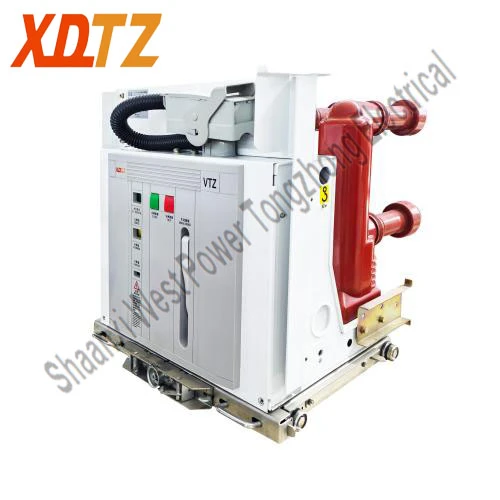

12KV/24KV/40.5KV vacuum circuit breakers
Reliable Vacuum Circuit Breakers, Customized for Global Clients
Professional Technical&Sales Team | On-Time Delivery
Shaanxi West Power Tongzhong Electrical Co., Ltd.
Our address
No.1 East Gaoxin Avenue, High-tech Development Zone, Baoji City, Shaanxi Province, China
Phone Number
+86 18091767067(WhatsApp/Wechat/Telegram)