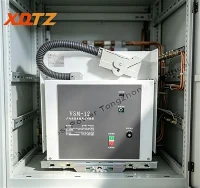


In the field of distribution network equipment, deep-fusion circuit breakers with embedded poles are gradually replacing traditional open-type pole-mounted switches. This type of pole, which encapsulates the vacuum interrupter, current and voltage sensors, and even the power-taking module into a single entity using epoxy resin, features a compact structure, high insulation strength, and maintenance-free operation. However, there is a crucial provision in industry standards that is easily overlooked: for circuit breakers of the same model, the installation method, terminal connection method, and connection dimensions of the vacuum interrupter must be unified.
The "Non-Replaceable" Property Cured in Resin
The essence of an embedded pole is to encapsulate the originally air-exposed vacuum interrupter and related conductive parts into a single unit using epoxy resin or thermoplastic material. With traditional open-type circuit breakers, replacing the vacuum interrupter only requires removing a few bolts. Once an embedded pole is formed, however, the interrupter is permanently embedded within the resin. If the installation interfaces are not unified, it means that poles from different batches of the same model cannot be interchanged, and the vacuum interrupter cannot be replaced independently. For power grid users who purchase in bulk, this directly affects later-stage operation and maintenance costs as well as power supply reliability.
The Hard Constraint of Three-Phase Consistency
Deep-fusion circuit breakers typically use three single-phase embedded poles arranged side by side, with the moving ends of the A, B, and C phase interrupters connected to the same operating mechanism through insulated pull rods. Even a millimeter-level deviation in installation method can cause the three phases to open and close asynchronously. When a vacuum circuit breaker interrupts a short-circuit current, the moment of contact separation across all three phases must be highly consistent. Otherwise, the arc energy distribution among the three phases becomes unbalanced, which at best accelerates contact erosion and at worst leads to interruption failure. Unifying the installation method is essentially about ensuring the consistency of three-phase mechanical characteristics.
Insulation Coordination Cannot Be "Installed However One Likes"
The insulation performance of an embedded pole depends on the thickness of the epoxy resin and the electric field distribution design. The installation position, tilt angle, and distance from the outlet terminals of the vacuum interrupter within the pole are all verified through electric field simulation and type tests. If the installation method is not unified, it is equivalent to altering the internal electric field structure of the pole-partial discharge levels may exceed limits, and insulation margins may decrease. Deep-fusion poles also integrate sensors and power-taking modules internally. Changes in the installation posture of the vacuum interrupter may disturb the electric field around the sensors and affect measurement accuracy.
In the final analysis, unifying the installation method is not merely a "management requirement" but a physical constraint inherent to the integrated structure of embedded poles. The moment the vacuum interrupter is cast into place, the performance of the pole is already "locked in." Only by unifying the interface from the very beginning can it be guaranteed that every embedded pole leaving the factory is the same reliable product.

12KV/24KV/40.5KV vacuum circuit breakers
Reliable Vacuum Circuit Breakers, Customized for Global Clients
Professional Technical&Sales Team | On-Time Delivery
Shaanxi West Power Tongzhong Electrical Co., Ltd.
Our address
No.1 East Gaoxin Avenue, High-tech Development Zone, Baoji City, Shaanxi Province, China
Phone Number
+86 18091765882(WhatsApp/Wechat/facebook)