

The application and evolution of circuit breakers in the power industry have a long history. Starting with breakers that naturally elongated arcs in air to interrupt currents, the field progressed through various forms of oil-filled breakers (both high-oil and low-oil types), gas-extinguishing breakers.
As early as 1893, Rittenhause discovered that vacuum possesses strong arc-quenching capabilities for alternating current arcs, for which he obtained a patent. In 1926, Professor Sorensen of the California Institute of Technology published experimental data and analysis results on vacuum circuit breakers, predicting that the era of vacuum circuit breaker application would soon arrive. However, the then-underdeveloped vacuum circuit breaker technology significantly delayed its industrial implementation. Subsequently, numerous manufacturers engaged in both product development and fundamental theoretical research, driving the advancement of this technology.
Vacuum circuit breakers are evolving toward higher voltage and larger capacity applications. Improvements in contact structure represent one of the most significant drivers of technological advancement in this field. Japan pioneered the invention of longitudinal magnetic field contacts, initially in coil form, which later evolved into various structural configurations.
Compared to transverse magnetic field contacts, longitudinal magnetic field contacts offer significantly greater breaking capacity at equivalent diameters. When breaking currents are identical, the electrical erosion rate of longitudinal magnetic field contacts is substantially lower than that of transverse magnetic field contacts, resulting in a much longer electrical life.
The development of vacuum circuit breakers is clearly trending toward higher capacity, higher voltage, lower overvoltage, and miniaturization. Typically, contact materials are required to have high breaking capacity, high withstand voltage, low current-carrying level, low electrical wear rate, and good resistance to melting. However, no single material has yet been able to simultaneously meet all these requirements. Some manufacturers employ copper-chromium alloys for contacts. The negligible vapor pressure difference between copper and chromium prevents significant material composition changes within the arc zone. Under arc action, copper and chromium melt into essentially flat shapes. Their smooth melt zones gradually harden without distortion from protrusions, pits, or cracks. The flat contact surfaces enable sufficiently short contact gaps and minimize contact material volume (as large amounts of vaporized material deposit onto the opposite contact for reuse). The rapid hardening of the melted flat surfaces ensures a swift increase in electrical strength after current interruption. Increasing chromium content prevents contact welding.
The shielding cover of a vacuum arc extinguishing chamber typically employs a center-sealed structure, which improves electric field distribution and enhances insulation strength.
The nation's first 10kV, 1.5kA three-phase vacuum circuit breaker was successfully developed in 1964. Medium-voltage circuit breakers entered formal production in 1973, followed by low-voltage vacuum contactors in 1978. Since 1978, significant advancements have been made in both technology and production volume/variety. Currently, China's 10–35kV voltage-rated circuit breakers have reached a mature stage of development.
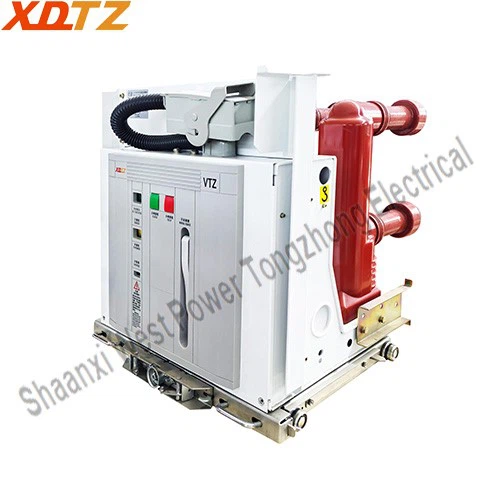
VTZ-12 1250A vacuum circuit breaker is maked by Shaanxi West Power Tongzhong Electrical Co., Ltd.is an indoor switchgear for rated voltage 12kV,1250A, AC 50/60Hz. It adopts a modular operating mechanism and is suitable for various industrial and mining enterprises, as well as power grid equipment. It can be used as a handcart unit for use with KYN28A-12 switchgear, or as a fixed unit with relevant mechanical interlocking, making it suitable for XGN2 and other fixed cabinets.
VTZ-12 1250A vacuum circuit breaker has many advantages:
1.PERFORMANCE OF CIRCUIT BREAKER:
E2-C2-M2
2.CONVENIENT MAINTENANCE:
the modular mechanism design allows for easy replacement of the closing and opening coils without the need for dismantling other components. This eliminates the need for testing or adjustment after replacement, ensuring users to replace them independently, making subsequent maintenance more convenient.
HIGH CONDUCTIVITY PERFORMANCE:
the product features a well-designed conductive circuit that meets 1.1 times the rated current temperature rise level.
3.WIDE APPLICATION RANGE:
the product series has a wide application range, rated currents from 630A to 5000A, and rated breaking currents from 20kA to 50kA. It is suitable for all environments within an altitude of 4500 meters and an operating temperatures from -40°C to 40°C.
4.SUPPORTS INTELLIGENT CUSTOMIZATION:
a. It can add a wireless temperature monitoring solution with self-powered design to ensure safety and maintenance-free operation.
b. It has a mechanical characteristics monitoring solution to provide real-time monitoring of circuit breaker operating data for early detection and resolution of potential problems.
c. It has a motorized cabinet entry solution to allow remote operation for ensuring personal safety.
d. Real-time component aging can be detected by partial discharge testing.
Shaanxi West Power Tongzhong Electrical Co., Ltd.
Email :xdtz04@westpowerelectric.com
Contact: Ms.Grace Liu (Director of Sales Department)
Tel: +86 917 3661109 Fax: +86 917 6739416
Mobile: +86 18091765882(WhatsApp/Wechat/skype )
Website:https://www.xdtzelectrical.com
Add: Nanpo Village, Chencang Avenue Jintai District Baoji City, Shaanxi Province, China.