
Interrupting Small Inductive Currents (e.g., unloaded transformers, small motors, reactors)
Core characteristic: Current is forcibly "cut off," resulting in current chopping.
1. Physical Process
The current in an inductor coil cannot change abruptly (iL is continuous). When the circuit breaker trips, the arc in the vacuum interrupter is elongated and cooled. Due to the extremely rapid recovery of the vacuum medium strength, the arc may be forcibly extinguished before the power frequency current reaches its natural zero point (e.g., when the current is still several amperes or even tens of amperes).
2. Why Does Current Chopping Occur?
The vacuum arc has a strong arc-extinguishing capability. When the current decreases to a certain level (called the "current chopping value" Ichop ), the metal vapor provided by the cathode spot is insufficient to sustain the arc, and the arc will suddenly extinguish.
3. Overvoltage Generation Mechanism:
At the instant the arc extinguishes (t0 ), the inductor current iL = Ichop (assuming a positive direction). At this time, the magnetic field energy stored on the inductor load is 21 LIchop2 .
Because current cannot change abruptly, this current will immediately charge the stray capacitance C on the load side. According to U=C1 ∫idt, the capacitor voltage will rise sharply.
Theoretically, the peak overvoltage across the break can reach:
Umax =U0 +Ichop CL where U0 is the instantaneous value of the power supply voltage, L is the load inductance, and C is the equivalent capacitance to ground.
Result: Current-cutting overvoltage. The multiple of this overvoltage is directly proportional to the current-cutting value Ichop and inversely proportional to the loop capacitance C. The smaller the equivalent capacitance of the load (e.g., a large-capacity transformer with very short leads), the smaller C is, and the higher the overvoltage, which may endanger the inter-turn insulation of the winding.
Breaking small capacitor currents (e.g., unloaded cables, capacitor banks, long lines)
Core characteristics: The current naturally crosses zero and extinguishes the arc, but it is prone to restrike/reignition.
1. Physical process: The capacitor current leads the voltage by 90°. When the capacitor current iC naturally crosses zero (t=0), the power supply voltage is exactly at its peak ±Um.
At this time, the capacitor plates are fully charged, the voltage =Um, the circuit breaker contacts have just separated, and the arc gap is recovering.
Why is it difficult to cut off the current?
Because it is capacitive current, the arc temperature is low when the current crosses zero, making it easy to extinguish. Furthermore, the arc extinguishes naturally upon crossing zero, and there is no forced premature interruption of the current, so the concept of "current cutting off" is essentially nonexistent.
Overvoltage generation mechanism (re-breakdown): After the arc extinguishes upon crossing zero, one side of the break is the power supply voltage us (t)≈0 (changing at zero), and the other side is the trapped capacitor voltage uc =Um
The transient recovery voltage ur =uc −us will oscillate and rise from Um at the power supply frequency.
If the dielectric strength recovery rate of the vacuum gap cannot keep up with the rise rate of ur (especially the initial high-frequency oscillation), the insulation will break down-that is, re-breakdown.
Once a re-breakdown occurs, the power supply voltage us will charge and discharge capacitor C, generating high-frequency oscillations. If the capacitor re-breaks down again after the current crosses zero and the arc is extinguished, a higher overvoltage may occur.
Result: Re-ignition overvoltage (multiple re-ignitions can reach 3-5 times the phase voltage). For capacitor banks, selective phase closing or synchronous switching is often used to avoid pre-breakdown and re-ignition.
Comparison and Summary Table
comparison of product parameters
|
Item |
Current interruption in small inductors (e.g., no-load transformers) |
Low-capacitance current interruption (e.g., capacitor banks) |
|
Typical loads |
Transformers, reactors, motors |
Capacitors, long cables, and open circuits |
|
Characteristics of the Current Waveform |
The current is forcibly turned off before it reaches zero |
Natural current zero-crossing arc extinction |
|
Main Phenomena |
Current Chopping |
Restrike |
|
Energy Sources |
Magnetic energy stored in an inductor 21LI2 |
Energy exchange between the power supply and the capacitor |
|
Types of Overvoltage |
Clamping overvoltage (high-frequency attenuation) |
Reignition overvoltage (high-frequency oscillation) |
|
Hazardous Insulation |
Turn-to-turn and layer-to-layer insulation (high-frequency steep-fronted waves) |
Insulation to ground and phase-to-phase (higher amplitude) |
|
Common Restrictive Measures |
Parallel surge arresters, RC absorbers, and low-breaking-capacity switches |
Synchronizing switch, closing resistor, current-limiting reactor |
Summary
Inductive load: Current wants to continue flowing but is suddenly stopped → Voltage rises sharply → Current-chopping overvoltage.
Capacitive load: Voltage is trapped (charge trapped), recovery voltage is too high, breaking down the gap → repeated charging and discharging → reignition overvoltage.
hot sell product
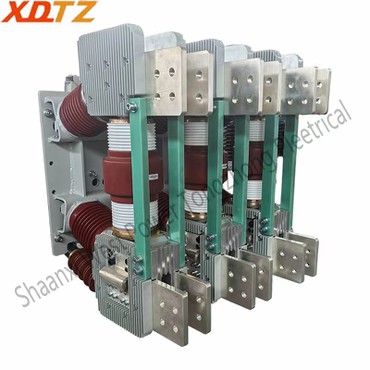
VTZ-15/T5000-63 indoor high-voltage generator circuit breaker is a vacuum circuit breaker designed for generator outlets in 15 kV and lower, three-phase AC 50 Hz systems. It is primarily utilized in the plant auxiliary circuits of small to medium-sized hydroelectric generator units, thermal power generators, new energy generation systems, and industrial facilities-such as those in the chemical and processing sectors-that operate with their own captive power generation capabilities.
Shaanxi West Power Tongzhong Electrical Co., Ltd.
Our address
No. 1 East Gaoxin Avenue in the High-Tech Development Zone of Baoji City, Shaanxi Province,china
Phone Number
86-18091765882(whatsapp/telegram/facebook/wechat )
xdtz04@westpowerelectric.com