
Characteristics of Mechanical Loads

Initial Stage: Overcoming the Resistance of the Operating Mechanism
This is the beginning of the closing process, and the load mainly comes from within the operating mechanism.
Static Resistance: Includes the preload of the opening spring (the opening spring needs to be compressed before closing), the preload of the contact spring, and the force of various return springs.
Dynamic Resistance: Friction between moving parts such as connecting rods, crank arms, and bearings in the mechanism. Poor lubrication or wear of parts will significantly increase this load.
Inertial Force: To meet the closing time requirements, the operating mechanism (such as spring, hydraulic, or electromagnetic mechanisms) needs to drive the entire motion system to accelerate, which generates an inertial load.
Pre-Contact Stage: Pre-breakdown and Electrodynamic Force
Before the physical contact between the moving and stationary contacts, when the gap narrows to a certain distance, pre-breakdown will occur under the action of the power supply voltage, forming an electric arc.
This will result in:Lorentz electrodynamic force (repulsive force): The pre-breakdown current generates a magnetic field in the arc between the contacts and in the conductive circuit of the contacts.
This magnetic field interacts with the current, generating an electrodynamic repulsive force that causes the contacts to repel each other.
This force attempts to prevent the contacts from closing, increasing the closing force required by the operating mechanism. For closing large currents (such as short-circuit currents), this force can be very large.
Contact collision and closing stage: Impact and bounce
This is the stage with the most severe mechanical load and the greatest impact on the equipment.
Collision impact force: The moving contact strikes the stationary contact at its final velocity (typically 0.8~1.5 m/s), generating a huge instantaneous impact force. This force is transmitted through the contacts, conductive rods to the insulators and frame, potentially causing mechanical vibration.
Contact bounce: The collision inevitably leads to a brief rebound and re-closing of the contacts. During bounce:
Re-arcing: The bounce gap can cause the arc to reignite, potentially causing localized melting and welding (fusion welding) of the contact surface.
Repeated Impact Load: Multiple collisions generate repeated impact stresses, posing a severe test to the mechanical strength of the contact materials and operating mechanism. Reducing bounce time and amplitude is a key design objective for vacuum circuit breakers.
Contact Pressure Establishment: After the collision, the operating mechanism needs to continue moving, compressing the contact springs until the rated contact pressure required by the design is established.
This force needs to be large enough to ensure: Low contact resistance, preventing overheating during normal current carrying.
Resisting the enormous electrodynamic repulsive force generated by the short-circuit current, preventing the contacts from being "blown open".
Closing End Point (Lock-in) Stage
Braking and Locking The moving contact completes its overtravel and reaches the closing end point.
Braking and Buffering: The operating mechanism needs to be effectively braked (e.g., oil buffer, rubber buffer) to absorb remaining kinetic energy and avoid rigid impact.
The performance of the buffer directly affects the smoothness of closing and the stress borne by the frame.
Mechanism Lock-in: The closing holding (lock-in) device needs to reliably lock, maintaining the circuit breaker in the closed position.
There is also a certain impact load at the moment of locking.
Products Description
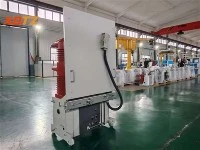
ZND-12X Permanent Magnet Operating Mechanism Vacuum Circuit Breaker
small size
adopts a magnetic control operating mechanism
Wide Application
can be used to open and close various electrical loads

Contact Us

Shaanxi West Power Tongzhong Electrical Co., Ltd.
Contact: Melody Sun (Export Sales manager)
Mobile: +86 180 9176 5658 (WhatsApp/Wechat)
Website: www.xdtzelectrical.com