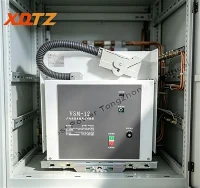

The spring operating mechanism of medium and high voltage circuit breakers is a widely used mechanical operating mechanism. Its core principle is to utilize the energy released by a pre-stored spring to drive the circuit breaker to complete the opening and closing operations. The following will detail its working process, including a structural overview, energy storage, closing and opening procedures.
Core Structure and Energy Flow
The spring mechanism mainly consists of the following key components:
1. Energy Storage System: This includes the energy storage motor, reduction gears, energy storage ratchet/cam, and closing spring.
2. Energy Retention/Release Device: The closing latch (catch), which is used to maintain the spring's energy storage state and release it upon receiving a command.
3. Transmission Linkage System: Converts the spring's energy into the linear motion of the moving contact.
4. Opening System: This includes the opening spring (usually weaker, used to accelerate the opening), opening latch, and opening coil.
5. Control Components: Closing coil, opening coil, auxiliary switch, energy storage status indicator, etc.
Core energy flow:
Electrical energy (motor) → Mechanical energy (spring energy storage) → Release to drive the movement of the moving contact.
Detailed Operating Procedure
Phase One: Spring Energy Storage Process
This is the prerequisite for all operations. The spring must be compressed and energy stored before closing the switch.
1. Start Energy Storage
When the spring is not energized, the energy storage status indicator of the mechanism shows "Not Energized".
The control circuit connects the power supply to the energy storage motor (which can be started manually or automatically).
2. Energy Storage:
The motor drives the energy storage main shaft to rotate through a reduction gear set.
The cam or eccentric wheel on the main shaft gradually compresses the closing spring (usually a huge helical spring or torsion spring), causing it to deform and store a large amount of mechanical energy.
3. Energy Storage Maintenance:
When the spring is compressed to the maximum extent (energy storage is completed), the closing latch (catch) automatically engages under the force of the spring, locking the main shaft to prevent it from rotating back.
The energy storage status indicator changes to "Energized", and the auxiliary switch is actuated to cut off the motor power supply, stopping the motor.
At this point, the circuit breaker is ready to receive a closing command at any time.
Stage Two: Closing Operation Process
After the closing command is issued, the mechanism releases the stored spring energy to push the main contacts of the circuit breaker to close.

1. Closing command trigger:
A closing signal is sent remotely or locally, energizing the closing coil (or manually pressing the closing button).
The core of the coil moves, striking or pulling the closing latch (catch), releasing it.
2. Energy release and transmission:
After the closing latch is released, the locked energy storage main shaft rotates at high speed under the action of the powerful closing spring.
The rotation of the main shaft is converted into linear motion of the circuit breaker's insulating pull rod through a precise four-bar linkage (or cam-linkage mechanism) for motion and force transformation.
3. Contact closure:
The insulating pull rod drives the moving contact in the circuit breaker's arc extinguishing chamber to move rapidly upwards (or horizontally) and make reliable contact with the stationary contact, completing the circuit connection.
At the end of the closing process, the mechanism automatically performs two key actions:
a. Re-energizing the opening spring: In the final stage of the closing action, the opening spring is stretched or compressed through the linkage to store energy for the next opening.
b. Re-energizing the closing spring (optional, for automatic reclosing mechanisms): Some designs start the motor at the end of the closing process to immediately begin the next energy storage; others start the energy storage after the closing is completed.
4. State maintenance:
After the closing is completed, the opening latch locks, keeping the circuit breaker in the closed position.
The auxiliary switch changes state, cutting off the closing circuit and preparing to connect the opening circuit.
Stage Three: Opening Operation Process
The opening mainly relies on the stored energy of the opening spring, and the energy requirement is much less than that for closing.
1. Opening command trigger:
The protection device issues a tripping signal or manual opening is performed, and the opening coil is energized.
The core of the opening coil moves, striking the opening latch to release it.
2. Rapid tripping:
After the opening latch is released, the energy stored in the opening spring is instantly released.
Through the transmission mechanism, it drives the moving contact to move rapidly downward (or in the opposite direction) and separate from the static contact. The arc is quickly extinguished in the arc extinguishing chamber, and the circuit is disconnected.
core features
1. Energy Independence: The operating energy comes from the spring and is independent of the instantaneous value of the grid voltage, ensuring high reliability.
2. Clear "Close-Open" Sequence: Energy must be stored before closing; during the closing process or after closing, it automatically stores energy for opening.
3. High Operating Power: The spring can store significant energy, making it suitable for high-voltage and ultra-high-voltage circuit breakers that require large operating power.
4. Long Mechanical Life: Key components have good wear resistance, and the mechanical life typically ranges from several thousand to tens of thousands of cycles.
5. Reclosing Capability: It can perform a rapid automatic reclosing of "O-0.3s-CO" (after the first opening, the spring is re-energized within a short time to complete the closing).
6. Maintenance Focus: Spring fatigue characteristics, wear and precision of the locking device, and lubrication conditions are the key points for maintenance.
Working cycle status diagram
Initial state: Open position, spring not energized
↓ (Energizing motor starts)
State A: Open position, spring energized
↓ (Receive closing command)
State B: Closing process (Spring releases, drives closing, and simultaneously energizes the opening spring)
↓ (Closing in place)
State C: Closed position, opening spring energized, closing spring may not be energized
↓ (Receive opening command)
State D: Opening process (Opening spring releases)
↓ (Opening in place)
State E: Open position, closing spring not energized (Return to initial state or state A)
In summary
In summary, the spring operating mechanism achieves reliable, rapid and automatic control of the circuit breaker's opening and closing operations through the mechanical logic of motor pre-storing energy - latch holding - electromagnetic triggering and release. It is one of the most mainstream and classic operating mechanism forms for modern medium and high-voltage circuit breakers.
vS1-12 vacuum circuit breaker
VS1-12 vacuum circuit breaker is an indoor switch equipment with a rated voltage of 12kV and AC 50/60Hz. It adopts an integrated frame operating mechanism and is suitable for various industrial and mining enterprises, as well as power grid equipment. It can be used as a handcart unit for use with KYN28A-12 switchgear, or as a fixed unit with relevant mechanical interlocking, making it suitable for XGN2 and other fixed cabinets.

contact us
 Shaanxi West Power Tongzhong Electrical Co., Ltd.
Contact: Ms.Grace Liu (Director of Sales Department)
Email:xdtz04@westpowerelectric.com
Mobile: +86 18091765882(WhatsApp/facebook )
Website:https://www.xdtzelectrical.com
Add: Nanpo Village, Chencang Avenue Jintai District Baoji City, Shaanxi Province, China.