

Can a vacuum circuit breaker be started directly without a contactor?
Yes, but this isn't a simple matter of "omitting a component," but rather an engineering choice based on load type, control requirements, and operating conditions.
In industrial electrical control, circuit breakers and contactors each have their specific functions.
Circuit breakers primarily handle protection-breaking the circuit when an overload or short circuit occurs, protecting equipment and cables;
contactors primarily handle control-used for frequently starting and stopping motors.
Normally, they are a perfect "protection + control" partnership, neither can be omitted.
However, under certain specific conditions, the contactor can indeed be omitted, and the circuit breaker can directly handle the starting task.
When can a contactor be omitted?
The most common situations are for equipment that needs to run continuously for extended periods after startup and doesn't require frequent start-stop cycles. For example, water pumps, fans, and air conditioning units in factories may run continuously for hours or even days after startup, with very few start-stop cycles. In such cases, a circuit breaker with an electrically operated mechanism can be selected, allowing direct control of the circuit breaker's closing and opening via buttons, thereby starting or stopping the load. Another typical scenario is fire pumps and emergency fans-these devices are not normally started, only used in emergencies, with extremely low usage frequency, but extremely high reliability requirements. Fire safety regulations sometimes encourage direct-start circuit breakers because circuit breakers are simpler in structure and have fewer potential failure points than contactors; eliminating an intermediate link actually increases reliability.
why can't contactors be omitted in most cases?
The core reason lies in mechanical lifespan and control flexibility.
The mechanical lifespan of a circuit breaker is typically between 10,000 and 30,000 cycles, while that of a contactor can reach over a million cycles. If the load requires frequent start-stop operations-such as cranes, conveyor belts, and machine tools-the circuit breaker will quickly become worn out and unusable.
More importantly, contactors can implement complex control logic: forward and reverse switching requires two contactors interlocked, star-delta reduced voltage starting requires a set of contactors for switching, and soft starters and frequency converters also rely on contactors for bypassing or isolation.
Circuit breakers cannot perform these functions. Furthermore, the electric operating mechanism of a circuit breaker can only perform simple "on" and "off" operations, and cannot be easily integrated with a PLC for automated control like a contactor.
how do you determine if a contactor can be omitted from a project?
There's a simple method: ask the client three questions.
First, how many times a day will this equipment be started and stopped? If more than ten times, it's recommended to retain the contactor.
Second, does it require forward/reverse rotation, speed regulation, or reduced voltage starting? If any of these are answered "yes," a contactor is necessary.
Third, is it fire-fighting or emergency equipment? If so, direct-start with a circuit breaker can be considered, which is actually more reliable. For ordinary equipment, if start-stop is infrequent, control is simple, and the budget is tight, using a circuit breaker with electric operation for direct-start can indeed save the cost of a contactor and cabinet space.
However, for equipment with frequent operation or complex control, forcibly omitting the contactor might result in the loss of a few hundred dollars, potentially leading to premature circuit breaker failure and production line downtime.
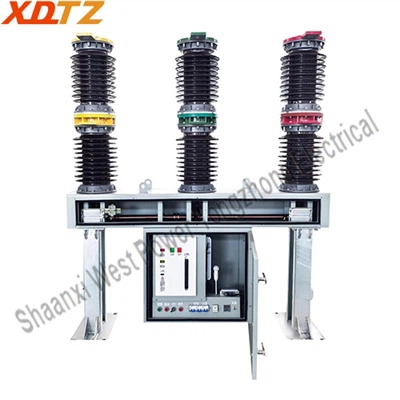
ZW7-40.5 Outdoor Vacuum Circuit Breaker With External Current Transformer
2. Operating Mechanism: Modular operating mechanism.
3. Installation Method: Fixed installation with outdoor support.
4. Product Compliance with Standards: GB/T1984-2014, GB/T11022-2011.
5. Product Advantages: E2-C2-M2 performance, easy maintenance, standardized outdoor design, wide range of applications, and external current transformer.
Our address
No. 1 East Gaoxin Avenue Baoji, Shaanxi, China
Phone Number
+86 180 9176 5658
xdtz03@westpowerelectric.com