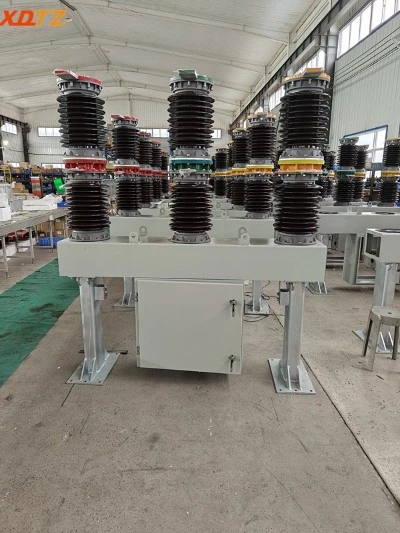

In simple terms, anti-tripping interlocking protection is a protection mechanism designed to prevent dangerous "trip-close" oscillations in circuit breakers in a power system (which can be imagined as a remotely controlled, high-power "light switch").
Below is a detailed explanation of its principle and function:
What is the "tripping" phenomenon?
"Tripping" is an abnormal and dangerous cycle of repeated tripping and closing of a circuit breaker.
A typical scenario is as follows: When a line fault occurs (such as a short circuit), the protection device automatically trips the circuit breaker to disconnect the fault. However, if, for some reason (such as the operator's control switch being stuck, or the closing contacts of the automatic device being stuck), the closing command persists, the circuit breaker that just successfully tripped will immediately receive a closing command to close again. But the fault point is often not yet eliminated, so the protection device will immediately trip again. This cycle repeats itself, and the circuit breaker will repeatedly cycle "trip-close-trip-close" in a short period of time, like a "frog jumping."
How does anti-pumping interlocking protection work?
The core task of anti-pumping interlocking protection is to ensure that the circuit breaker can only complete one "closing" operation under a closing command. Once a "closing to a fault" situation occurs, it immediately "remembers" this state and locks the circuit breaker in the tripped position, preventing it from closing again regardless of whether a closing command is still in effect.
Electrical anti-pumping: This is the most common method, achieved by adding a special relay (called an "anti-pumping relay") to the secondary control circuit. When the circuit breaker closes to a fault and trips, this relay immediately activates and "self-holds," disconnecting the closing circuit with one of its normally closed contacts, effectively cutting off the "circuit path" of the closing command and preventing the possibility of re-closing.
Mechanical anti-pumping: This method relies on the mechanical structure design of the circuit breaker's operating mechanism itself. After a circuit breaker completes one closing operation, its internal mechanism changes state. Even if the closing command persists, the mechanical structure prevents a second closing operation until the mechanism is reset.
These can be understood as two different levels of protection mechanisms: electrical anti-pumping acts like blocking the "command transmission" stage, while mechanical anti-pumping locks the "command execution" stage. To more clearly illustrate their differences, I have compiled a comparison table:
comparison of Electrical anti-tripping and Mechanical anti-jump
|
Comparison criteria |
Electrical anti-tripping (using an anti-tripping relay) |
Mechanical anti-jump (using the operating mechanism) |
|
Implementation |
In the secondary control circuit, logical interlocking is achieved by adding a special anti-bounce relay (com.monly referred to as a TBJ) -2-8. |
Inside the circuit breaker's operating mechanism, interlock 1-3-6 is achieved through sophisticated mechanical design (such as linkages, stops, and auxiliary contact interlocks). |
|
Trigger logic |
This is a "series anti-tripping" device (-8-10). It is triggered by the tripping process. When the protection device issues a tripping command, current flows through the TBJ's current coil, causing it to activate. If a closing command is still present at this point, the TBJ's voltage coil will self-hold, using its normally closed contacts to interrupt the closing circuit (-2-8-10). |
This is a type of "parallel anti-tripping" mechanism -8-10. It is triggered by the closing process. When a closing command is issued, the closing mechanism actuates; however, if a second closing attempt is required due to some reason (such as the mechanism jamming and failing to close successfully), a set of mechanical interlocks within the mechanism will activate, directly breaking the circuit of the closing coil to prevent a second closing attempt -8-10. |
|
Protected Entities |
System and electrical equipment. The primary purpose is to prevent circuit breakers from repeatedly closing at the point of failure when a permanent fault occurs in the system, thereby avoiding repeated impacts on the power grid and equipment caused by massive short-circuit currents and preventing the accident from escalating-8–10.
|
Circuit breaker body. Its primary function is to prevent the circuit breaker from being subjected to multiple closing impacts within a short period of time due to mechanical failures (such as incomplete closing or bounce) or improper operation, thereby protecting the delicate arc-extinguishing chamber (such as the vacuum bulb) and the operating mechanism-8–10.
|
|
Advantages |
Reliable operation, clear logic, and easy to modify and design based on existing control loops. |
It responds quickly and does not rely on complex secondary circuits, effectively preventing "jumping" caused by mechanical failures at the source. |
|
Disadvantages |
It is not possible to prevent tripping caused by faults in the circuit breaker mechanism itself (such as incomplete closing)-8–10.
|
Some argue that purely mechanical anti-jump mechanisms are sometimes unreliable-4-as they involve more complex designs, and any issues that arise are difficult to resolve on-site.
|
From this table ,we know Electrical anti-tripping is "post-event protection": It mainly targets external electrical causes-that is, after the circuit breaker successfully closes, it is tripped by the protection device due to a line fault, but the closing command fails to disappear due to contact sticking or other reasons. Its core task is to prevent repeated closing under fault conditions.
Mechanical anti-pumping is a form of "preemptive protection": it primarily targets issues caused by the circuit breaker itself-that is, during the closing process, the circuit breaker fails to close successfully due to its own mechanical problems and remains in the closed position, while the closing command is still in effect. Its core task is to prevent continuous impact on the circuit breaker body in the event of a mechanical malfunction.
in summary
Because the two protection mechanisms have different focuses, in modern high-voltage switchgear, these two anti-pumping functions usually coexist, playing a complementary role,and neither is dispensable.
zND-12X permanent magnet vacuum circuit breaker
The ZND-12X permanent magnet vacuum circuit breaker is a widely applicable vacuum circuit breaker with a rated voltage of 12kV and AC 50/60Hz. It adopts a magnetic control operating mechanism, has a very small size, and can be used to open and close various electrical loads. It is widely used in urban power grids, rural power grids, and other power grid construction and product upgrading projects, and is especially suitable for frequent operation applications.

Shaanxi West Power Tongzhong Electrical Co., Ltd.
Our address
No. 1 East Gaoxin Avenue in the High-Tech Development Zone of Baoji City, Shaanxi Province,
86-18091765882
xdtz04@westpowerelectric.com