

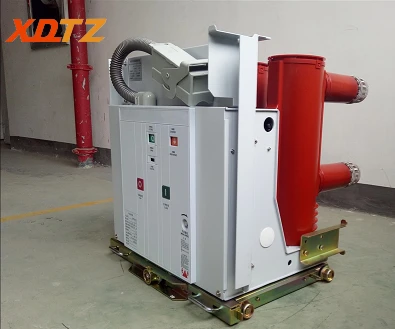
In low-voltage power distribution systems, circuit breakers act as "gatekeepers" for circuit safety. However, frequent tripping during actual operation often causes headaches for maintenance personnel. Tripping is not simply a equipment failure; it usually points to four core causes. Clarifying these causes is a prerequisite for efficient fault diagnosis and ensuring power supply reliability.
overload is the most common tripping condition
The essence of overload is the heat accumulation effect. When high-power loads such as air conditioners and electric water heaters are connected to the circuit simultaneously, the operating current approaches or exceeds the circuit breaker's rated threshold for an extended period. According to Joule's law, an increase in current causes the heat generated in the line to increase quadratically. The bimetallic strip inside the circuit breaker bends and deforms due to heat, triggering tripping when the operating threshold is reached. It is worth noting that excessively thin cables or loose connections at the terminals significantly increase contact resistance. The resulting localized high temperature further exacerbates heat accumulation, causing the circuit breaker to trip abnormally even when the total power is not exceeded.
short-circuit faults are the most destructive cause
When a phase conductor is in direct contact with the neutral conductor, or when a phase conductor is short-circuited to ground, the circuit impedance instantly approaches zero, and the short-circuit current can reach tens of times the rated current. At this time, the electromagnetic trip unit inside the circuit breaker will trigger instantly, achieving "zero-delay" instantaneous tripping. Short circuits usually originate from damage to the insulation layer of the line caused by external force, or breakdown of internal components of electrical appliances (such as capacitors and power transistors). Such faults are often accompanied by obvious characteristics such as a burning smell and smoke. During troubleshooting, all loads must be disconnected first, and then the fault point must be located by segmented insulation resistance testing.
leakage current tripping is often misdiagnosed as a short circuit
Circuit breakers with leakage current protection (RCBO) have a built-in zero-sequence current transformer to monitor the vector sum of the phase conductor and the neutral conductor. When the insulation of the line or equipment ages or becomes damp, causing some current to leak through the grounding path, the vector sum is not zero. Once the residual current exceeds the set operating value (usually 30mA in household applications, and 30mA-300mA in industrial applications), the residual current protection module triggers a trip within milliseconds. The typical characteristics of this type of fault are: immediate tripping after closing, and the reset button (leakage current indicator) pops out, which is clearly different from the behavior of overload or short circuit.
the condition of the equipment itself and environmental interference should not be ignored
After repeated high-current interruptions, contact erosion of the circuit breaker leads to increased contact resistance, resulting in additional temperature rise under normal load and causing thermal tripping malfunctions. In addition, in high-temperature and high-humidity environments, parameter drift of electronic components or strong electromagnetic interference with the residual current detection circuit may also cause non-faulty tripping.
In summary, troubleshooting tripping problems should follow the principle of "external first, internal second; simple first, complex second." First, disconnect all loads and test power restoration. If it still trips, focus on checking line insulation and short circuits; if it trips under load, calculate the power and wire diameter matching. Accurately locating the cause is crucial to eliminating hidden dangers at the source and ensuring long-term system stability.
If you want to know more about VTZ-12 Series Indoor Phase-selective Switching Intelligent Vaccum Circuit Breaker , please contact us at anytime.
Shaanxi West Power Tongzhong Electrical Co., Ltd.
Our address
Nanpo Village, Chencang Avenue Jintai District Baoji City, Shaanxi Province, China.
Phone Number
+86 18091765882(WhatsApp/Wechat/facebook)