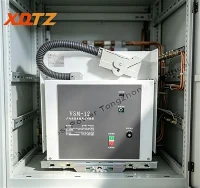

Medium-voltage vacuum circuit breakers are core control and protection devices in power distribution systems. Whether the wiring method is correct or not directly affects the safe and stable operation of the equipment. Below, I will introduce in detail the wiring methods, principles, and precautions for medium-voltage vacuum circuit breakers (typically referring to voltage levels of 3.6kV - 40.5kV).
Overview of Main Wiring Parts
A complete medium-voltage vacuum circuit breaker that is ready for wiring typically includes the following terminals:
1. Main circuit connection terminals: Located at the top and bottom of the circuit breaker, they are used to connect the primary system (high-voltage part).
Upper connection terminal: Usually connected to the power supply side (such as busbar, transformer).
Lower connection terminal: Usually connected to the load side (such as outgoing cable, motor).
Note: For fixed circuit breakers, some are designed as "top in and bottom out", while others as "bottom in and top out". It is necessary to confirm according to the product manual and cabinet structure. For withdrawable circuit breakers, after being pushed into the working position, their moving contacts will automatically connect with the static contacts inside the cabinet (busbar side and cable side).

2.Control and auxiliary circuit connection terminals:
Located on the secondary terminal block of the circuit breaker (usually an independent aviation plug or terminal block), they are used to achieve functions such as control, protection, signaling, and energy storage.
Wiring Method and Steps for the Main Circuit
Core principle: Ensure electrical clearance, insulation strength, and reliable current-carrying connections.
1. Preparation
Power off and test for electricity: Ensure the circuit breaker is in the off position and test for electricity on both sides of it.
Cleaning and inspection: Clean the circuit breaker terminal board (conductive contact surface), and check for oxidation and burrs. Gently sand with fine sandpaper and apply special power compound grease (conductive paste).
Check materials: Prepare suitable copper busbars or cable terminals (wire lugs), fastening bolts, flat washers, spring washers, etc. The specifications must meet the design current and dynamic and thermal stability requirements.
2. Connection Methods
Copper busbar connection: The most common method.
1) Bend and cut the copper busbars according to the phase sequence (A/B/C or L1/L2/L3, corresponding to yellow, green, and red) and the specified installation distance.
2) Align the holes on the circuit breaker terminal board.
3) Use bolts, nuts, and washers of the specified torque to tighten. A torque wrench must be used to tighten to the torque value provided by the manufacturer to prevent overheating due to looseness or damage to the threads due to over-tightening.
Cable connection:
1) Use crimp terminals (wire lugs) that match the cable cross-section.
2) Crimp the cables strictly in accordance with the process to ensure a firm connection and low contact resistance.
3) Connect the flat end of the cable terminal to the circuit breaker terminal board and tighten to the standard torque.
3. Phase Sequence and Phase Position
It is essential to ensure that the phase sequence on both sides (inlet and outlet lines) of the circuit breaker is consistent. After installation, a phase sequence meter should be used for verification.
For multiple circuit breakers operating in parallel, their phase positions must strictly correspond to those of the busbar.
4. Safety Distance
Ensure that the clear air gap and creepage distance between each phase conductor, as well as between the conductor and the ground (cabinet), comply with national standards (such as GB standards) and the design requirements of the switchgear.

Wiring of Control and Auxiliary Circuits
This part is the key to the "intelligentization" and "automation" of circuit breakers, and it is usually carried out on terminal blocks or aviation plugs.
Core principles: Follow the drawings for construction, ensure clear numbering, and make firm connections.
1. Reading the drawings: It must be done in accordance with the secondary wiring diagram provided by the circuit breaker manufacturer and the cabinet principle diagram.
Power circuit: It provides the operating energy. Commonly, it is DC 110V/220V or AC 220V. Distinguish the positive and negative poles (+KM, -KM).
Closing circuit: It includes the closing coil (YC), closing button, normally closed contacts of protection relays, auxiliary contacts indicating the completion of energy storage, etc.
Opening circuit: It includes the opening coil (YT), opening button, and the output contacts of various protections (relay protection, integrated protection device).
Energy storage circuit: For spring operating mechanisms, it includes the energy storage motor and the travel switch contacts.
Signal circuit: It provides status indication, such as:
Closing position indication: A normally open auxiliary contact (DL) in series with a red light.
Opening position indication: A normally closed auxiliary contact in series with a green light.
Energy storage indication: The travel switch contact for energy storage.
Unstored energy contact: Used to lock the closing circuit.
Accident trip signal: Contacts used to drive the "accident sound" (wiring based on the "non-correspondence" principle).
2. Wiring Steps
Cable checking: Use a continuity tester or multimeter to verify that the numbers at both ends of the cable cores correspond exactly.
Wiring: Connect the cable cores to the corresponding terminals as per the drawing. Ensure a firm crimp, with generally no more than two wires per terminal.
Cable arrangement: Bundle the cable harness neatly, fix it securely, avoid sharp bends, and leave some slack. Try to separate the strong and weak current wires when routing.
Grounding: Connect the grounding terminal of the circuit breaker (if available) reliably to the grounding busbar of the switch cabinet.
Special Function Wiring (if required)
Current transformer: Circuit breakers often have CTs for protection and measurement purposes installed inside. The secondary windings (S1, S2) of the CT must be connected to the terminal block inside the cabinet through dedicated leads, and then to the protection and measurement devices. Remember that the secondary side of the CT must not be open-circuited.
Intelligent controller/online monitoring: For intelligent circuit breakers, it may be necessary to connect signal lines for temperature sensors, mechanical characteristic monitoring, etc. Wiring and settings must be strictly carried out in accordance with the instructions of the intelligent unit.
Inspection and Testing after Wiring Completion
1. Mechanical inspection: Manually store energy and perform opening and closing operations several times to confirm that the mechanism operates flexibly without jamming.
2. Circuit insulation test: Use a megohmmeter (such as a 1000V insulation resistance tester) to measure the insulation resistance of the secondary circuit to ground (should be > 1MΩ). Before testing, all electronic devices (protection devices, intelligent units, etc.) must be disconnected to prevent high voltage damage.
3. Circuit conduction test: Use a multimeter to check the on-off status of each control circuit (such as closing and opening circuits) and whether the auxiliary contacts operate correctly.
4. Operating voltage test: Perform opening and closing operations at 80% and 110% of the rated operating voltage to check their reliability.
5. Main circuit resistance test: Use a circuit resistance tester (micro-ohmmeter) to measure the contact resistance of each phase of the main circuit of the circuit breaker, which should comply with the factory standards.
6. Power frequency withstand voltage test: For newly installed or overhauled circuit breakers, the main circuit should be subjected to a power frequency withstand voltage test in accordance with the regulations to verify its insulation strength.
Important Safety Notice
Professional operation: The wiring of medium-voltage equipment must be carried out by qualified professional electricians or technicians.
Strict power-off: All work must be conducted under the safety measures of complete power-off, voltage testing, and grounding wire installation.
Follow documents: Always follow the installation and operation manual provided by the equipment manufacturer and the engineering design drawings as the highest guidance.
Torque tightening: The torque for tightening the bolts of the main circuit connection is crucial. A torque wrench must be used.
Double-check confirmation: Before power is restored, a systematic recheck must be conducted by a second person to ensure everything is correct.
Summary
In conclusion, the wiring of medium-voltage vacuum circuit breakers is a systematic and rigorous project. It requires the reliable connection of the main circuit's large current and the precise logical control of the control circuit to be combined. Only by strictly following the regulations and drawings can the safety, reliability, and longevity of the equipment after commissioning be ensured.
VTZ-12 indoor phase-controlled high-voltage vacuum circuit breaker
VTZ-12 indoor phase-controlled high-voltage vacuum circuit breaker (Tongzhong Electric's special model) is an indoor switchgear for rated voltage 12kV, AC 50/60Hz. It adopts a permanent magnet operating mechanism and is suitable for special occasions in various industrial and mining enterprises and power grid equipment. The trolley unit can be directly used with the KYN28A-12 switchgear, directly replacing the ordinary three-phase integrated vacuum circuit breaker in the existing switchgear.

Shaanxi West Power Tongzhong Electrical Co., Ltd.
Our address
Nanpo Village, Chencang Avenue Jintai District Baoji City, Shaanxi Province, China.
Phone Number
+86 18091765882 (whatsapp)