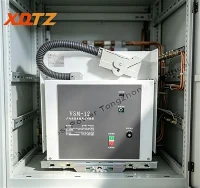

Fault diagnosis for 10kV vacuum circuit breakers is a core task in distribution networks. The following content provides a clear, practical, and step-by-step fault diagnosis guide tailored to the characteristics of the 10kV voltage level.
Core Mnemonic: Observe symptoms first, then identify root causes; examine secondary circuits before primary circuits; address electrical issues before mechanical ones.
Universal Fault Diagnosis Process ("Observe, Listen, Question, Examine, Measure")
1."Observe" - Examine Phenomena
* Status Indicators:
Cabinet indicators: Check status lights for "Closed," "Open," "Charged," "Uncharged," "Test/Operating Position," etc.
Body Indicators: Observe the mechanical position pointer on the circuit breaker panel (critical, as it accurately reflects contact position), comparing it with cabinet indicators and actual conditions.
* Visual Inspection:
Insulation Components: Check ceramic or organic composite insulators (bushings) for cracks, tracking marks, or black spots from discharge burns.
Connection Points: Inspect main circuit terminals and busbar connections for overheating discoloration (blackening, bluish tint), corrosion, or melting.
Pressure Relief Window: Some circuit breakers feature transparent pressure relief windows. Observe for abnormal metallic vapor deposits (fogging) inside, which may indicate reduced vacuum integrity.
2."Smell" - Listen and Detect Odors
Abnormal Sounds:
During operation: Continuous hissing discharge sounds (possibly indicating internal insulation or vacuum issues), or humming resonance noises.
During operation: Check if the closing/opening sounds are crisp and forceful. Dull, sluggish, impact noises, or "clicking" jamming sounds indicate mechanical issues.
Odor:
Detect ozone smell upon approach (indicating arcing or burnt insulation material).
3."Ask" - Gather Contextual Information
Inquire with operating personnel:
- Did the fault occur during operation or suddenly while running?
- Were there prior abnormal alarms (e.g., protection tripping, grounding signals)?
- What were the load conditions and weather (thunderstorms?) at the time of failure?
Review records: Review the circuit breaker's inspection logs, last maintenance date, mechanical characteristic test data, and historical loop resistance data for longitudinal comparison.

4."Cut" - Initial Isolation and Manual Inspection (Under Safe Conditions!)
Safety Measures: Confirm the circuit breaker is fully de-energized (isolated from both sides), verify voltage absence, install grounding wires, and hang a "Work in Progress, Do Not Operate" sign.
Manual Operation
Manually perform closing and opening operations to detect any sticking or binding.
Components Inspection: Examine internal linkages, levers, and springs for deformation, fractures, corrosion, or pin detachment. Verify proper engagement of auxiliary switch contacts.
Fasteners: Inspect all visible bolts and nuts for looseness.

5. "Measure" - Instrument Diagnosis (Critical Step)
|
Test item |
Use the instrument |
Purpose and Judgment Criteria |
Common Fault Indicators |
|
Insulation Resistance Test |
2500V/5000V Megohmmeter |
Measure phase-to-phase, phase-to-ground, and break-to-break (closed) insulation resistance. For 10kV equipment, the requirement is typically ≥ 1000 MΩ. Low values indicate moisture ingress, contamination, or damage to the insulation. |
Insulator degradation, internal moisture ingress, vacuum bubble surface tracking. |
|
Loop Resistance Test |
Loop Resistance Tester (100A DC) |
Measure the main circuit resistance for each phase. The measured value should be ≤ 1.2 times the factory value, and balanced across all three phases. An increased value is the direct cause of overheating faults. |
Contact wear and erosion; Loosening and oxidation of conductive connection surfaces (bolts). |
|
Main Circuit DC Resistance Test |
As above |
Measurements taken at the open position can assist in determining the internal connection status. |
|
|
Vacuum Level Detection
|
Power Frequency Withstand Voltage Test Equipment (Preferred) |
The most reliable method. With the circuit breaker in the open position, apply a 42kV power frequency voltage between the breakers and maintain it for one minute. No flashover or breakdown indicates a pass. If sustained discharge or breakdown occurs, the vacuum bulb has failed and must be replaced. |
Vacuum loss in the vacuum arc extinguishing chamber. |
|
Vacuum Gauge |
Quantifiable measurement with high precision, but the equipment is relatively specialized. |
|
|
|
Mechanical Properties Testing |
Circuit Breaker Characteristic Tester | Measure closing/opening time, speed, synchronism, contact bounce time, travel, and overtravel. Compare with factory settings or previous data. Excessive bounce time, low speed, and significant synchronism deviation are primary fault points. |
Actuating mechanism jamming, buffer failure, spring fatigue, connecting rod deformation. |
|
Secondary Component Inspection |
Multimeter |
Measure the DC resistance of the closing and tripping coils (typically tens to hundreds of ohms) to check for burnout (infinite or reduced resistance). Inspect the continuity and contact resistance of the energy storage motor, interlock electromagnet, microswitch, and auxiliary switch contacts. |
Control circuit failure causing failure to operate o |
Typical Faults and Rapid Diagnosis of 10kV Vacuum Circuit Breakers
Fault 1: Failure to Close or Open (Operational Failure)
Diagnostic Approach:
Listen for sounds: If completely silent after command → Check control power supply, fuses, emergency stop button, interlock circuit.
If a "click" sound occurs but no movement: Coil activated but mechanism jammed → Focus on mechanical components (linkage, trip plate, latch).
Electrical circuit troubleshooting: Using a multimeter, measure voltage step-by-step from the command source to locate breaks (coil, auxiliary switch, terminal block, cable core).
Mechanical troubleshooting: Manually energize and operate to detect resistance points. Verify spring is fully energized, check for foreign object jams in mechanism, and ensure lubrication is not depleted.
Fault 2: False Trip (Unintended Disengagement)
Diagnostic Approach:
Inspect protection devices: Check for fault records (short circuit, overcurrent, ground fault protection tripping). If none exist, suspect protection malfunction or poor secondary circuit insulation.
Focus on DC system: Verify DC operating power supply has no double-grounding points causing tripping circuits to erroneously engage.
Inspect mechanism: In high-vibration environments, mechanical vibration may cause unintended tripping.
Fault 3: Vacuum Degradation (Core Fault)
Symptoms: May manifest as internal discharge sounds during operation; failure to pass power frequency withstand voltage test.
Golden Rule: Power frequency withstand voltage testing is the definitive criterion for vacuum integrity. If breakdown occurs during testing, further evaluation is unnecessary-immediately replace the vacuum arc extinguishing chamber.
Note: When the vacuum circuit breaker is in the open position, the insulation strength at the break points significantly exceeds that of other areas. Therefore, withstand voltage testing primarily evaluates insulation between break points.
Fault 4: Overheating
Symptom: Ground-to-phase or phase-to-phase flashover, short-circuit explosion.
Diagnosis: After the fault, assess damage extent via insulation resistance testing and withstand voltage testing. Focus on inspecting insulator surfaces for through cracks, condensation/contamination, and moisture in insulating rods.
Safety Red Lines
1. All work must be performed only after complete safety measures are in place (power off, voltage verification, grounding, tagging)!
2. During withstand voltage tests, personnel must stay clear of the tested equipment, and a dedicated supervisor must be present.
3. Fault diagnosis and repairs must be conducted by certified professionals.
4. After replacing the vacuum arc extinguishing chamber or major components, a full set of mechanical characteristics, loop resistance, and withstand voltage tests must be performed and passed before recommissioning.
5. Establish equipment archives and retain all historical test data, as this constitutes invaluable information for assessing equipment condition trends.
VS1-12 vacuum circuit breaker
VS1-12 vacuum circuit breaker is an indoor switch equipment with a rated voltage of 12kV and AC 50/60Hz. It adopts an integrated frame operating mechanism and is suitable for various industrial and mining enterprises, as well as power grid equipment. It can be used as a handcart unit for use with KYN28A-12 switchgear, or as a fixed unit with relevant mechanical interlocking, making it suitable for XGN2 and other fixed cabinets.

contact us
Shaanxi West Power Tongzhong Electrical Co., Ltd.
Contact: Ms.Grace Liu (Director of Sales Department)
Email:xdtz04@westpowerelectric.com
Mobile: +86 18091765882(WhatsApp/Wechat/facebook)
Website:https://www.xdtzelectrical.com
Add: Nanpo Village, Chencang Avenue Jintai District Baoji City, Shaanxi Province, China.