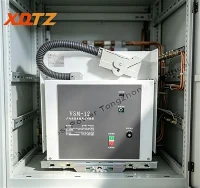

Concept and Funtions

A zero-sequence current transformer (CCT) is a single-turn, through-hole device used to monitor zero-sequence current in power systems.
A Zero Sequence Current Transformer is a core component of power protection devices and is primarily used for ground fault detection, leakage protection, and insulation monitoring.
This device triggers protection by detecting the three-phase current vector sum (zero-sequence current). It can be linked with low-current grounding line selection devices, microcomputer-based detuning devices, and relay protection devices to implement fault warnings and power shutdown functions.
Its structure utilizes a toroidal core and secondary winding encapsulated in an epoxy resin or silicone rubber casing, providing moisture resistance and pollution flashover resistance. Mounting options include integral and split-type options.
This product utilizes Rogowski coil technology to convert current-to-voltage signals, covering voltage levels from 0.4 kV to 66 kV and operating environments from -10°C to 40°C.
It supports 50 Hz grid frequency detection, and its sensitivity and linearity meet the requirements of various power system operating modes, including grounded and ungrounded neutral points. It is widely used in smart grids, rail transit, building electrical systems, and industrial equipment monitoring.
Concept and Funtions
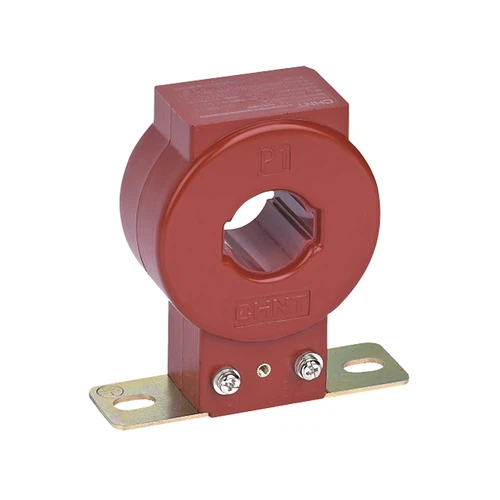
A current transformer uses the principle of electromagnetic induction to convert large primary currents into smaller secondary currents for measurement.
A current transformer consists of a closed iron core and windings. Its primary winding has a small number of turns and is connected in series with the circuit to be measured.
Thus, the entire circuit current always flows through it.
The secondary winding has a larger number of turns and is connected in series with the measuring instrument and protective circuit.
During operation, the secondary circuit of the current transformer is always closed, resulting in a very low impedance between the series coils of the measuring instrument and protective circuit, and the current transformer operates in a state close to a short circuit.
A current transformer converts a large primary current into a smaller secondary current for measurement; the secondary circuit cannot be open-circuited.
Comparisions
A Zero Sequence Current Transformer-CCT VS A Current Transformer
|
Feature |
Standard Current Transformer (CT) |
Zero-Sequence Current Transformer (ZSCT) |
|
Primary Purpose |
Measurement (metering, instrumentation) and Protection (overcurrent, fault protection) |
Dedicated Protection (detecting ground faults, i.e., earth leakage currents) |
|
Current Detected |
Phase Currents (Ia, Ib, Ic) or Line Currents |
Zero-Sequence Current (I₀), the vector sum of three-phase currents (Ia + Ib + Ic) |
|
Operating Principle |
Measures the current in a single conductor. |
Measures the vector sum of currents in all three phases (and sometimes the neutral) simultaneously. |
|
Structural Key |
Single core, a single primary conductor passes through. |
Single large core, all three (or four) primary conductors pass through together. |
|
Normal State |
Secondary outputs a current proportional to the primary load current. |
Under balanced conditions, secondary output is theoretically zero. |
|
Fault State |
Operates when the current exceeds a pre-set value. |
Operates when a ground fault creates an imbalance, resulting in a zero-sequence current (I₀). |
|
Typical Applications |
Connected to ammeters, wattmeters, overcurrent relays. |
Connected to earth fault relays, ground fault circuit interrupters (GFCIs / RCDs), and insulation monitoring systems. |
Contact Us

Shaanxi West Power Tongzhong Electrical Co., Ltd.
Contact: Ms.Melody
Email: xdtz03@westpowerelectric.com
Tel : +86 18091765658(WhatsApp)