

Both voltage transformers and current transformers must be grounded. The core purpose is singular: to prevent high-voltage current from the primary side from entering the secondary side, thus protecting personnel and equipment safety. Furthermore, this grounding point also eliminates "floating potential," ensuring accurate measurements.
Why must voltage transformers and current transformers be grounded?
1. Safety Protection: The Most Important "Fuse"
In power systems, the primary side of a transformer connects to high-voltage lines, while the secondary side connects to measuring instruments and relay protection devices, requiring frequent contact by operators.
Preventing High-Voltage Breakdown: If the insulation between the primary and secondary windings of a transformer breaks down due to aging, moisture, or overvoltage, high voltage (e.g., 10kV, 35kV) from the primary side will directly enter the secondary circuit. In this situation, all secondary equipment and wiring will be carrying dangerously high voltage, directly threatening the lives of operators.
The function of protective grounding: After reliably grounding one end of the secondary side, in the event of a high-voltage surge, a huge fault current will quickly flow into the ground through the grounding point, forcibly clamping the voltage on the secondary side to ground potential (i.e., zero potential), thus ensuring that personnel standing on the ground will not be electrocuted when touching secondary equipment.
2. Eliminating "Floating Potential": Preventing Accidental Voltage Injuries.
Distributed capacitance exists between the primary and secondary windings of an instrument transformer, and between the secondary winding and ground. During normal operation, the voltage division effect of these capacitances will cause the ungrounded secondary winding to generate a floating potential relative to ground, i.e., a certain voltage exists. Although this voltage is usually not high, it can still cause injury to weakly insulated secondary equipment or personnel under certain circumstances. Grounding the secondary side eliminates this floating potential.
3. Providing a Fault Current Path: Ensuring Reliable Protection Device Operation
In certain systems (such as low-current grounding systems), grounding the neutral point on the primary side of the voltage transformer provides a path for the system's zero-sequence current. This allows the insulation monitoring device to correctly detect the zero-sequence voltage and issue an alarm signal when a single-phase ground fault occurs, alerting operators to handle the situation promptly.
Special Note: A Key Engineering Principle
Although the secondary side must be grounded, in a connected secondary circuit (e.g., the entire circuit from the transformer to the control room), there can only be one grounding point.
If two or more grounding points exist, because the substation grounding grid is not perfectly equipotential, a potential difference will be generated between the different grounding points when a large current (such as a short-circuit fault current) is injected into the grid. This creates an additional circulating current in the secondary circuit, leading to inaccurate measurement data and even causing relay protection devices to malfunction or fail to operate, resulting in serious consequences.
Products Description
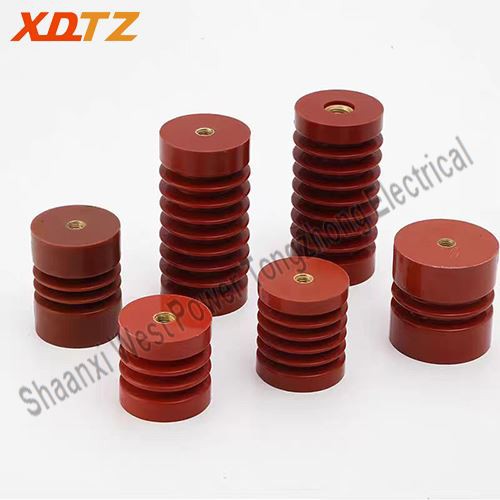
24kV sensor is suitable for three-phase AC systems power stations and substation distribution equipment with a rated voltage of 24kV and a frequency of 50~60Hz.
It is used to allow conductive parts to pass through partitions, walls, or other grounded objects, providing insulation support and establishing a secure connection with external conductors (busbars).
Our address
No. 1 East Gaoxin Avenue, Baoji, Shaanxi, China
Phone Number
+86 180 9176 5658
xdtz03@westpowerelectric.com