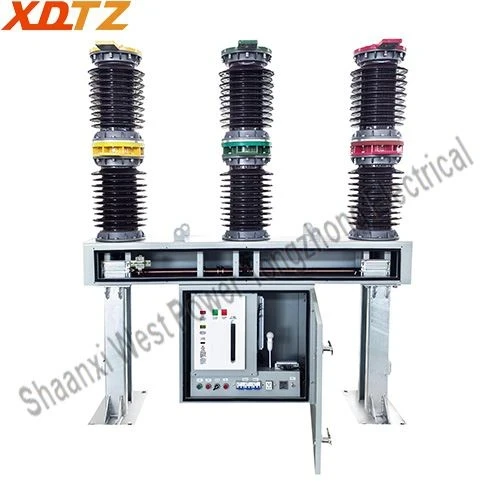

The frequent tripping of 35kV vacuum circuit breakers in wind farms is fundamentally attributed to the Fact that their operating environment and working conditions differ significantly from those of conventional power grids.
The collector lines in wind farms stretch for dozens of kilometres, often traversing open mountainous areas or coastal zones, where they endure persistent wind, wide temperature fluctuations, and high humidity, all of which readily degrade the insulation strength of equipment.
Meanwhile, the switching operations of the vacuum circuit breakers themselves generate severe voltage fluctuations. The combination of these internal electrical stresses and external environmental factors serves as the primary driver behind tripping events.
Analysis of causes of tripping situations
More specifically, tripping is typically triggered by two categories of conditions.
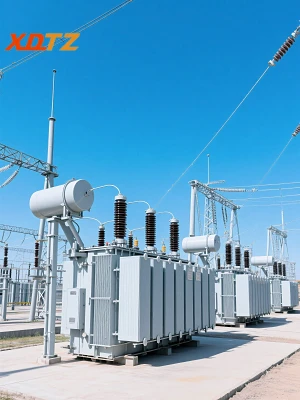
- The first is insulation breakdown caused by voltage surges: when the vacuum circuit breaker interrupts inductive loads such as wind turbine transformers, the forced interruption of current produces voltage spikes several times higher than the normal value. These surges propagate along the cables and, upon encountering weak insulation points such as cable joints or terminations, can cause a breakdown and short circuit, thereby activating the protection relay.
- The second is protection Operational error: due to the large capacitance-to-ground of long lines, there is already a small unbalanced current under normal operation. If the protection settings are overly sensitive, transient currents caused by lightning strikes or switching operations can easily result in nuisance tripping.
- Additionally, high‑frequency harmonics generated by the turbine converters may intrude into the measurement circuits, interfering with proper sampling by the protection devices and leading to trip commands even in the absence of an actual fault.
How to reduce trip frequency?
To reduce the frequency of tripping, attention must be paid to both equipment protection and setting optimisation.
- On one hand, surge arresters or voltage‑limiting devices can be installed on the outgoing side of the vacuum circuit breakers to mitigate peak overvoltages, and periodic partial discharge testing should be carried out on cable terminations to detect latent insulation defects.
- On the other hand, protection settings should be re‑evaluated based on the actual parameters of the lines, and filtering and isolation modules should be added in the secondary circuits to prevent interfering signals from entering.
Only by simultaneously improving hardware protection and software‑based setting coordination can the operational reliability be fundamentally enhanced, thereby avoiding the generation losses caused by unplanned outages.
If you are interested in the zw7-40-5-outdoor-vacuum-circuit-breaker please feel free to contact me at any time.
Shaanxi West Power Tongzhong Electrical Co., Ltd.
Our address
No.1 East Gaoxin Avenue, High-tech Development Zone, Baoji City, Shaanxi Province, China
Phone Number
+86 18791707667(WhatsApp/Wechat)