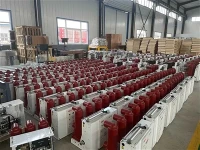

Part 1: Opening and Closing Methods of a Vacuum Circuit Breaker
The "opening and closing" of a circuit breaker is not simply "open" and "close." Depending on the circuit state during operation, it can be divided into the following main methods:
1. Closing (Closed Operation)
This is the process of changing the circuit breaker from the open state to the closed state.
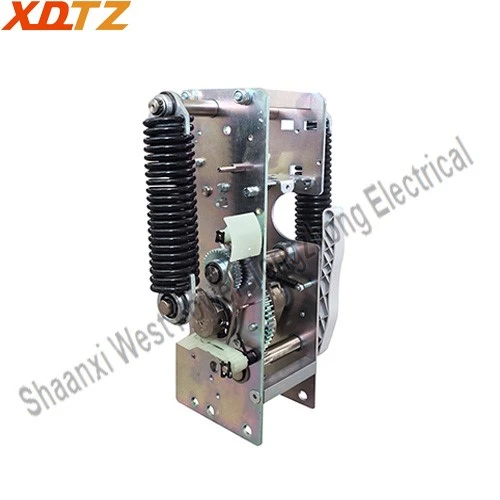
A. Process: The operating mechanism (such as a spring mechanism or permanent magnet mechanism) drives the moving contact of the vacuum interrupter to move towards the stationary contact at an extremely high speed.
B. Key Point: At the instant the contacts are about to make contact, due to the extremely high electric field strength, pre-breakdown may occur. That is, before the contacts make physical contact, the gap is broken down by the electric field, and current is conducted first. This will cause slight erosion of the contacts. Successful closing requires the circuit breaker to withstand the huge short-circuit current that may occur at the moment of closing (i.e., closing capacity).
2. Breaking (Opening Operation)
This is the most core and complex function, referring to disconnecting the circuit under load current or fault current.
Process:
A. Contact Separation: Under the control system, the moving contact begins to separate from the stationary contact.
B. Arc Extinction: The vacuum arc is maintained by the metal vapor evaporated from the electrodes. When the alternating current naturally crosses zero, the arc temporarily extinguishes. At this time, the high insulation performance of the vacuum causes the metal vapor in the arc gap to diffuse and condense at an extremely fast speed, restoring it to metal particles that adhere to the shield and contact surface. The arc gap quickly returns to a high vacuum state, thus withstanding the recovery voltage and ultimately successfully breaking the circuit.
3. No-Load Switching
This refers to switching a "no-load line" or "no-load transformer" where no current flows. Although the current is very small or even zero, electromagnetic energy is stored in the line or transformer windings. During switching, current cut-off can easily occur, leading to operational overvoltage.
A. Current Cut-off: Due to the instability of the vacuum arc, before the current naturally crosses zero, when the current value is very small (usually a few amperes to tens of amperes), the vacuum arc may suddenly extinguish, forcibly "cutting off" the current to zero. According to the principle that inductor current cannot change abruptly (U = L * di/dt), this will generate extremely high induced overvoltages in the inductor (such as transformer windings).
4. Capacitive Current Switching
This refers to switching capacitor banks (such as reactive power compensation devices) or unloaded long cable lines. These loads are capacitive.
A. Risk: Interrupting capacitive current is relatively easy because the phase of the capacitive current leads the voltage by 90 degrees. When the current crosses zero, the power supply voltage reaches its peak value. After the circuit breaker extinguishes the arc, the charge on the capacitor cannot be released, maintaining this DC voltage (peak voltage).
B. Severe Breakdown: This is the main risk. If the insulation recovery strength between the circuit breaker contacts is insufficient, after half a power frequency cycle, when the power supply voltage reaches its reverse peak, the voltage difference across the contacts may reach twice the peak value of the system phase voltage, potentially causing the contacts to break down again, i.e., a re-breakdown. A re-breakdown causes high-frequency oscillations in the capacitor voltage, generating extremely high re-breakdown voltages, severely threatening the insulation of the capacitor and the system. Due to their extremely strong arc-extinguishing capability, vacuum circuit breakers have a very low probability of re-breakdown in modern designs.
Part Two: Transient Processes
Transient processes refer to the drastic changes in voltage and current in a circuit during the instant of opening and closing operations, transitioning from one stable state to another. Although these processes are brief, they can generate extremely high overvoltages and overcurrents, threatening the insulation of the equipment. The main transient processes in vacuum circuit breaker operation include:
1. Transient process when interrupting short-circuit current
Core physical phenomenon: Transient recovery voltage (TRV)
Description: The voltage appearing across the contacts after the current crosses zero and the arc is extinguished is called the recovery voltage. This voltage does not immediately stabilize to the power frequency supply voltage, but rather gradually recovers to the power frequency voltage from zero in the form of a high-frequency oscillation. This high-frequency oscillating voltage is called TRV.
Cause: The inductance and stray capacitance in the circuit form an oscillating loop. After the current is interrupted, the system's stored energy is exchanged between the inductor and capacitor, generating damped oscillations.
Importance: The rise rate (du/dt) and peak value of TRV are a severe test of the circuit breaker's arc-extinguishing capability. If the rise rate of TRV exceeds the recovery rate of the dielectric strength (insulation strength) of the break, the arc will reignite, leading to interruption failure. Vacuum circuit breakers, due to their extremely fast dielectric recovery rate, can withstand very steep TRVs.
2. Transient Process When Interrupting a Small Inductive Current (such as an Unloaded Transformer)
Core Physical Phenomenon: Current Cut-off and Overvoltage
Process: Current Cut-off Occurs: The vacuum circuit breaker forcibly extinguishes the arc before the current naturally crosses zero (at a very small current value), cutting off the current i₀.
Energy Accumulation: At this point, the magnetic energy 1/2 * L * i₀² stored in the transformer winding (large inductance L) cannot be released through the circuit.
Overvoltage Generation: This magnetic energy is transferred to the stray capacitance C to ground of the transformer winding itself, converting into electrical energy 1/2 * C * U².
Vacuum circuit breakers have become the dominant technology in the medium-voltage field precisely because of their superior performance in these transient processes (rapid dielectric recovery and strong breaking capacity).
VSM-12 indoor permanent magnetic vacuum circuit breaker
VSM-12 indoor permanent magnetic vacuum circuit breaker produced by Shaanxi West Power Tongzhong Electrical Co., Ltd. is used for rated voltage 12kV, AC 50/60Hz indoor switchgear, adopting monostable permanent magnetic actuator, frame one-piece layout, suitable for all kinds of industrial and mining enterprises, power grid equipment, trolley unit and KYN28A-12 switchgear supporting the use of the unit, but also can be used as a fixed unit with the corresponding position interlocking, used in the XGN2 and other Fixed cabinet.

contact us
 Shaanxi West Power Tongzhong Electrical Co., Ltd.
Contact: Ms.Grace Liu (Director of Sales Department)
Email:xdtz04@westpowerelectric.com
Mobile: +86 18091765882(WhatsApp/Wechat/facebook )
Website:https://www.xdtzelectrical.com