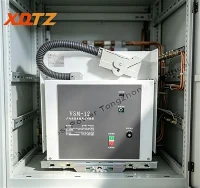

There are various types of contactors, depending on the control object and the number of units to be used. Different contactors and contactor lengths vary, so choose one based on your needs. Let's delve deeper into the important parameters to consider when selecting a vacuum circuit breaker.

1.Rated opening distance
When the vacuum circuit breaker is in the open state, the distance between the moving and static contacts of the vacuum switch tube is related to factors such as the rated voltage of the vacuum circuit breaker, operating conditions, the nature of the breaking current, the contact material, and the withstand voltage strength of the vacuum gap, and mainly depends on the rated voltage and contact material.
Since the rated opening distance of the vacuum switch tube has a great influence on the insulation performance, when the rated opening distance increases from zero, its insulation level will also improve. However, when the opening distance increases to a certain value, the influence of the opening distance on the insulation performance is not significant. If the opening distance is further increased, the mechanical life of the switch tube will be seriously affected.
Through the installation, operation and maintenance of vacuum circuit breakers, it is concluded that the general selection range of the rated opening distance of vacuum circuit breakers is: 6kV and below is generally 4-8mm, 10kV and below is generally 8-12mm, and 35kV is generally 20-40mm.
2.Contact travel
The selection of contact stroke must ensure that the contact can still maintain a certain pressure after wear; when opening the switch, the moving contact obtains a certain initial kinetic energy, which increases the initial opening speed of the switch, breaks the welding point, reduces the arcing time, and increases the medium recovery speed; when closing the switch, the contact spring can be used to obtain smooth buffering and reduce bounce.
If the switch contact travel is too small, the contact pressure after burnout cannot be guaranteed. If the initial speed of the switch is too slow, the vacuum circuit breaker's opening and closing and dynamic thermal stability will be affected, and severe closing bounce will occur. If the switch contact travel is too large, the closing work of the operating mechanism will be increased, or the closing function will become extremely unreliable. The contact travel of vacuum circuit breakers is generally 20% to 40% of the rated opening distance. The contact travel of a 10kV vacuum circuit breaker is generally 3 to 4mm.
3. Contact Operating Pressure
The operating pressure of a vacuum circuit breaker's contacts significantly impacts its performance. This pressure is equal to the sum of the vacuum interrupter's self-closing force and the contact spring force. The selection of the circuit breaker's contact operating pressure should meet four requirements:① Maintaining the contact resistance of the vacuum interrupter within the specified range; ②Meeting the requirements of dynamic stability testing; ③Suppressing closing bounce.
4. Reduce opening bounce
When closing a short-circuit current, a vacuum circuit breaker generates arcing and electrodynamic repulsion after pre-breakdown, causing the contacts to bounce and slowing down the closing mechanism. Therefore, the closing short-circuit current is the most critical criterion for evaluating whether the contact operating pressure meets the requirements.
If the contact working pressure is too low, the contact bounce time will increase when closing, and at the same time, the resistance of the primary circuit will increase, which will directly affect the long-term operating temperature rise of the vacuum circuit breaker. If the contact working pressure is too high, since the self-closing force of the vacuum switch tube is a constant value, the working pressure will increase, thereby increasing the spring force of the contact, resulting in an increase in the closing work of the operating mechanism, and increasing the impact and vibration on the vacuum tube.
In actual work, not only the electric force between the contacts must be considered, in addition to being related to the short-circuit current peak, but also the contact structure and size of the switch must be considered. At the same time, factors such as the hardness of the contacts and the opening speed must also be considered. In short, comprehensive considerations must be made in practice. The contact pressure of the vacuum switch is based on the breaking current size. The empirical data is that when the breaking current is 12.5kA, the selected pressure is 50kg. When the breaking current is 16kA, the selected pressure is 70kg. When the breaking current is 20kA, the selected pressure is 90~120kg. When the breaking current is 31.5kA, the selected pressure is 140~180kg. When the breaking current is 40kA, the selected pressure is 230~250kg.
5. Opening speed
Since the opening speed directly affects the speed at which the dielectric strength between the contacts recovers after the current passes through zero, if the recovery speed of the dielectric strength between the contacts is lower than the recovery voltage after the arc is extinguished, the arc will reignite. In order to prevent the arc from reigniting and shorten the arcing time, the opening speed must be met.The opening speed depends primarily on the rated voltage. For a given rated voltage and contact distance, the fluctuation range of the opening speed depends on factors such as the breaking current, load characteristics, and recovery voltage. When the breaking current is high, the opening speed should also be high. When breaking capacitive current, due to the high recovery voltage, the opening speed should also be high to reduce the chance of reignition. The opening speed of a 10kV vacuum switch is typically 0.8-1.2m/s, but can be higher than 1.5m/s if necessary.
In reality, initial tripping speed, not average tripping speed, has the greatest impact on breaking capacity. Consequently, some high-performance vacuum circuit breakers, including 35kV vacuum circuit breakers, typically measure tripping speeds within a few millimeters of the initial tripping point. While it might seem that a higher tripping speed is better, this isn't actually the case. A higher tripping speed results in more severe tripping spring vibration and overshoot, which in turn causes more severe vibration and compression of the switch bellows, potentially leading to premature failure and leakage. This also increases vibration of the motor, potentially damaging components.
6.Closing speed
Because vacuum interrupters have a relatively high static withstand voltage at rated opening distance, the closing speed of vacuum circuit breakers is significantly lower than their switching speed. To minimize electrical wear caused by pre-breakdown during the closing process and to prevent contact welding, a certain closing speed is essential. However, excessively high closing speeds not only increase the closing work of the operating mechanism but also increase the closing shock experienced by the interrupter, significantly reducing its service life. Typically, the closing speed of a 10kV vacuum circuit breaker is 0.4-0.7m/s, but can be increased to 0.8-1.2m/s when necessary.
7. Contact closing bounce time
The closing time of a vacuum circuit breaker is an important indicator of its performance. It is related to the contact bounce pressure, closing speed, opening distance and contact material of the vacuum switch tube, as well as the structure of the switch tube, the structure of the circuit breaker and its installation and commissioning.
The shorter the contact closing bounce time, the better the performance. A longer bounce time increases electrical wear on the contacts, which can easily lead to closing overvoltages. This can cause contact welding when closing short-circuit currents or capacitors, as well as during operation and thermal stability tests. Furthermore, a longer contact closing bounce time seriously endangers the service life of the switch bellows. The closing bounce time of a 10kV vacuum circuit breaker with copper-coated contacts does not exceed 2ms. Vacuum circuit breakers with other contact materials can have a slightly longer closing bounce time, but not exceeding 5ms.
8. Three-Pole Synchronicity
The three-pole synchronicity of a vacuum circuit breaker indicates the degree to which the three poles are not closed or opened simultaneously. Since opening and closing synchronicity are relative and the values are not significantly different, generally only the three-pole closing synchronicity is evaluated. Poor three-pole synchronicity will seriously affect the breaking capacity of the circuit breaker and easily result in excessively long arcing times. Due to the high opening and closing speeds and small opening distances of circuit breakers, achieving the required parameters is not difficult through accurate commissioning. Closing synchronicity is generally specified to not exceed 1ms.
9. Coaxiality of Moving and Static Contacts
For true switch tubes, there are specific requirements for the coaxiality of the moving and static contacts, which can be guaranteed through the manufacturing process. Whether the switch tube can maintain coaxiality when installed on the operating mechanism is directly related to the type of operating mechanism and the installation process. For suspended mechanisms, coaxiality is mainly determined by the operating mechanism. For floor-standing mechanisms, coaxiality is also significantly affected. During installation, the switch tube must be protected from shear and shear forces. Coaxiality is generally required to be no greater than 2mm.
Follow XDTZ to learn more electrical knowledge, the electrical management expert by your side!
Shaanxi West Power Tongzhong Electrical Co., Ltd.
Our address
Nanpo Village, Chencang Avenue Jintai District Baoji City, Shaanxi Province, China.
Phone Number
+86 18091767067(WhatsApp/Wechat/Telegram)