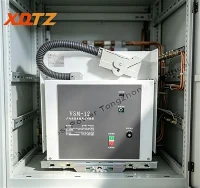

Sulfur hexafluoride circuit breaker vs. vacuum circuit breaker: Which is better?
1. Sulfur hexafluoride circuit breakers (SF6 circuit breakers)
SF6 has good chemical properties at room temperature. It only decomposes into S atoms and F atoms at high temperatures of several thousand degrees when the arc burns. After cooling, most of them are recombined into the original molecules; at high temperatures, a few SF6 atoms react with trace oxygen in the vapor of the contact metal material to form toxic low fluorides such as SOF2, SOF4, SF4, and SO2F2. In addition, SF6 has good insulation properties. At the same air pressure, its insulation strength is 2.5 to 3 times that of air. Increasing the gas pressure of SF6 can obtain higher insulation strength, but this increase is not linear. It shows a saturation trend at higher gas pressure, and the more uneven the electric field is, the lower the gas pressure when it is saturated. SF6 also has a strong electron affinity.
It is precisely because of this "soft" breaking characteristic that the 40.5kV sulfur hexafluoride circuit breaker is favored by operators. It is mainly selected for controlling transformers in order to safely cut off no-load transformer operations. This is why sulfur hexafluoride circuit breakers are still used to a certain extent in 35kV systems today.
2. Vacuum circuit breaker
Similarly, let's first explain the characteristics of vacuum media. Vacuum circuit breakers are developed based on the phenomenon that the contact gap can obtain high insulation strength and extinguish arcs in a vacuum medium. Circuit breaker vacuum, as a special insulating medium and arc extinguishing medium, has many unique properties, which are mainly:
(1) The distance between the fixed electrodes, the insulation strength of the gap increases with the increase of vacuum degree, but when a certain vacuum degree is reached, the insulation strength is saturated and no longer increases.
(2) It has better withstand voltage characteristics than other insulating media.
The role of the shell is to form a vacuum sealed container, while accommodating and supporting various parts in the vacuum arc extinguishing chamber. In order to ensure the reliability of the vacuum interrupter, the sealing performance of the shell is very high, and secondly, it must have a certain mechanical strength. The insulation is made of insulating materials such as hard glass, high alumina ceramics or microcrystalline glass, mainly ceramics. The end cover of the shell is usually made of metals such as stainless steel and oxygen-free copper.
The contact is the most important component in the vacuum interrupter. The breaking capacity and electrical life of the vacuum interrupter are mainly determined by the contact condition. At present, the contact system of the vacuum circuit breaker is docking in terms of contact mode. According to the different basic principles of arc extinguishing during breaking, the contacts can be roughly divided into two categories: non-magnetic blown contacts and magnetic blown (horizontal blown, longitudinal blown) contacts. Non-magnetic blown cylindrical contact. The cylindrical end face of the contact is used as the surface of electrical contact and arc burning. The vacuum arc is not affected by the magnetic field when burning between the contacts.
Compared with sulfur hexafluoride circuit breakers, vacuum circuit breakers have the following advantages:
(1) In addition, its sealing structure is also very complex. Each arc extinguishing chamber has a total of more than 20 parts. The more parts there are, the greater the possibility of hidden dangers of failure. The movable parts in the vacuum arc extinguishing chamber are only the moving contact and the bellows, which greatly improves the reliability.
(2) The initial recovery strength of vacuum dielectric insulation is high and the recovery speed is fast.
(3) It does not use SF6, which has a greenhouse effect, and there is no toxic fluoride produced after breaking, which is beneficial to the environment.
In general, vacuum and SF6 circuit breakers have their own unique advantages in different application scenarios. Users can choose circuit breakers that are more suitable for them based on different considerations.

ZW7-40.5 Outdoor Miniaturized Vacuum Circuit Breaker by Shaanxi West Power Tongzhong Electrical Co., Ltd. is a three-phase AC 50Hz, 40.5kV rated voltage outdoor high voltage equipment.It is used outdoor 110kV or 220kV substation, 35kV transmission and transformation power line,agricultural grid power system substation.
Product Advantages
1. Convenient maintenance: the modular mechanism design allows for easy replacement of the closing and opening coils without the need for dismantling other components. This eliminates the need for testing or adjustment after replacement, ensuring users to replace them independently, making subsequent maintenance more convenient.
2. Compact design: the product volume is significantly reduced compared to vacuum circuit breakers of other manufacturers, facilitating transportation and on-site installation.
3. Wide range of applications: designed to withstand harsh environments, the product can endure temperatures as low as -15°C and meet usage requirements up to an altitude of 1000 meters. Under special requirements, it can operate at temperatures as low as -40°C and altitude up to 2000 meters.
Should you have any requirements in these fields, please feel free to contact us as per following information:
Email: xdtz04@westpowerelectric.com
Website: https://www.xdtzelectrical.com/
Tel:+86 917 3661109
Mobilephone(whatsapp ): +86 18091765882