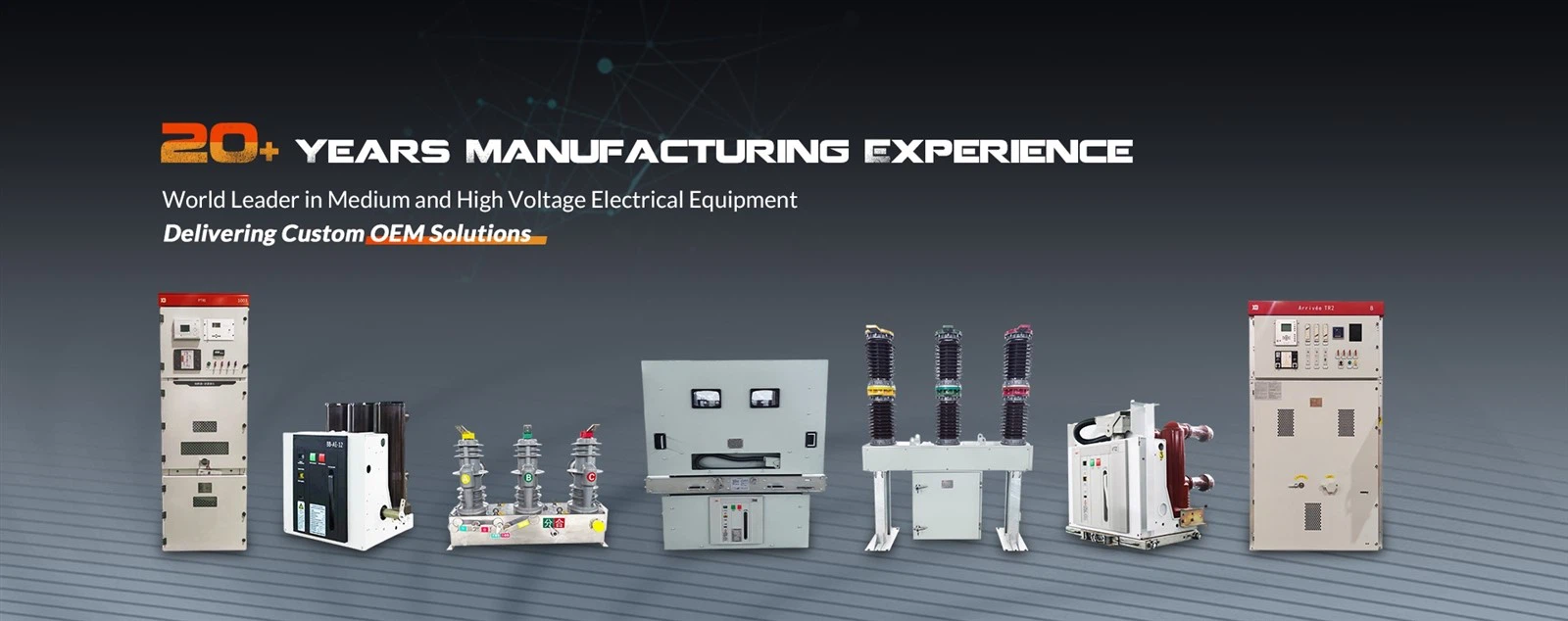

Power distribution is the final link in a power system that directly connects to users and distributes electrical energy to them.
Classification by Grounding Method
This is a key classification in electrical design and construction, related to electrical safety. The main types are as follows:
IT System: The power supply neutral point is not grounded. Its advantage is extremely strong power supply continuity; it will not trip when a single-phase ground fault occurs. It is commonly used in places where power outages are not easily tolerated, such as hospital operating rooms and mines.

TT System: The power supply neutral point is directly grounded, and the equipment casing is also separately grounded. Commonly seen in rural power grids and outdoor streetlights, but the fault current is relatively small, and a residual current device (RCD) is usually required.
TN System: Currently the most mainstream system, the power supply neutral point is directly grounded, and the equipment casing is connected to the grounding point through a protective earth (PE) conductor. It is further subdivided into:
TN-C System: The neutral (N) and ground (PE) conductors are combined into one (PEN conductor). It is low in cost but has poor safety, and is often seen in older buildings.
TN-S System: The neutral (N) and ground (PE) wires are completely separated, offering high safety and making it the preferred choice for modern residences, shopping malls, and computer rooms.
TN-C-S System: The front-end is integrated, but the wires are separated after entering the unit, balancing cost and safety, and is widely used in newly built commercial housing.
Development Trends: From Traditional to Intelligent
Against the backdrop of "dual-carbon" goals and energy transition, power distribution systems are undergoing profound changes, evolving from traditional unidirectional, passive networks to intelligent, proactive systems.
Traditional Power Distribution System: Power flows unidirectionally (from the grid to the user), operating passively, with its primary task being power distribution.
Modern Intelligent Power Distribution System: Evolves into a bidirectional, interactive intelligent platform.
Protection measures
Advanced and Auxiliary Protection
In more demanding scenarios (such as industrial applications and large buildings), more sophisticated protection measures will be deployed:
Short Circuit Protection: Utilizing the electromagnetic tripping of circuit breakers or the action of fuses within milliseconds to interrupt huge short-circuit currents.
Ground fault protection: Monitors abnormal current between the neutral and ground wires to prevent accidents caused by energized equipment casings.
Undervoltage/loss of voltage protection: Automatically trips when voltage drops abnormally to prevent sudden equipment startup and impact when the grid is restored.
Overvoltage protection: Protects against lightning strikes or operational overvoltages, typically handled by surge arresters or surge protection devices (SPDs).
Phase sequence/phase loss protection: Primarily used for three-phase motors to prevent motor burnout caused by reversed phase sequence or single-phase operation.
Special configurations for high-voltage systems:
If you are dealing with 10kV and above high-voltage power distribution, the protection strategy will be more complex, usually implemented by relay protection devices:
Instantaneous overcurrent protection: Reacts to short-circuit current, instantly clearing faults without delay.
Overcurrent protection: Time-delayed action, serving as backup for instantaneous overcurrent protection.
Differential protection: Determines internal faults by comparing incoming and outgoing currents; the most sensitive protection for transformers and busbars.
Gas protection: Specific to oil-immersed transformers, monitors gases generated by faults inside the tank.
Practical Application Recommendations:
Selective Coordination: The design should ensure "whoever fails, trips." For example, branch circuit breakers should trip before the main circuit breaker to prevent minor faults from causing a system-wide power outage.
Regular Verification: Protection devices are not a one-time solution after installation. Especially for residual current devices (RCDs) and circuit breakers, their operational reliability needs to be tested periodically by pressing the test button (usually marked "T")
ZND-12X permanent magnet vacuum circuit breaker
The ZND-12X permanent magnet vacuum circuit breaker is a widely applicable vacuum circuit breaker with a rated voltage of 12kV and AC 50/60Hz. It adopts a magnetic control operating mechanism, has a very small size, and can be used to open and close various electrical loads. It is widely used in urban power grids, rural power grids, and other power grid construction and product upgrading projects, and is especially suitable for frequent operation applications.

Shaanxi West Power Tongzhong Electrical Co., Ltd.
Our address
No. 1 East Gaoxin Avenue in the High-Tech Development Zone of Baoji City, Shaanxi Province,china
Whatapp
86-18091765882
xdtz04@westpowerelectric.com