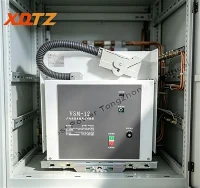

The core components of vacuum circuit breakers
In vacuum circuit breakers, the insulation pull rod is a core component connecting the operating mechanism to the moving contact of the vacuum interrupter. It undertakes the critical task of transferring operating power from the grounded part to the high‑voltage part.
It must withstand tensile and compressive forces of several kilonewtons, endure the highest operating voltage and impulse voltage stresses, and achieve tens of thousands of mechanical operations. Its performance directly determines whether the vacuum circuit breaker can operate safely.

From the perspective of force transmission
- From the force‑transmission perspective, the insulation pull rod typically contains elastic elements such as disc springs inside. During closing, these springs are compressed to provide a stable contact pressure between the fixed and moving contacts, ensuring reliable conduction.
- From the insulation perspective, early‑model vacuum circuit breakers used epoxy fiberglass pull rods, which, under polluted and damp conditions, exhibited creepage flashover voltages even lower than the rated voltage, making flashover accidents difficult to avoid.
- Today, synthetic insulation pull rods with silicone rubber sheaths can increase the dry flashover voltage by nearly 20% and more than double the pollution flashover voltage, better meeting the requirements of GB3906.
What consequences will it cause
Once the insulation pull rod fails, the consequences are extremely severe. In one substation, a vacuum circuit breaker that had been in service for only 20 months failed to interrupt after a lightning strike, eventually developing into a phase‑to‑phase short circuit, with the supporting insulators and the "insulation pull rod surface severely carbonised". At the Shuozhong Hydropower Station, a vacuum circuit breaker suffered from long‑term temperature rise exceeding limits, causing the "insulation pull rod to be completely carbonised and fractured", with large amounts of molten‑like carbonised residues remaining on the surface.
In another incident, a GIS high‑voltage switch failure at a hydropower station was directly attributed to "material quality issues of the insulation pull rod that led to fracture".
This component, combining both force transmission and insulation, is indeed an indispensable lifeline of the vacuum circuit breaker.
If you want to know more about LW25-126 Outdoor High Voltage Porcelain SF6 Circuit Breaker, please feel free to contact us at any time.
Shaanxi West Power Tongzhong Electrical Co., Ltd.
Our address
No.1 East Gaoxin Avenue, High-tech Development Zone, Baoji City, Shaanxi Province, China
Phone Number
+86 18091766017(WhatsApp/Wechat)