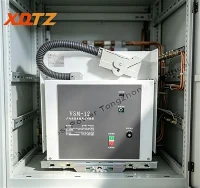

Disconnector, load switch and vacuum circuit breaker are three common switchgear in power systems. The main differences are reflected in the following aspects:
1. Core function differences
- Disconnector
Function: Mainly used to isolate power supply, establish insulation isolation of electrical equipment, and ensure maintenance safety.
Features: No arc extinguishing ability, can only operate without load, usually equipped with interlocking device to prevent load separation.
- Load switch
Function: It can cut off the rated load current and a certain overload current, but cannot cut off the short-circuit current.
Features: It has a simple arc extinguishing device, which can replace the circuit breaker for small current breaking, and is often used in combination with current limiting fuses.
- Vacuum circuit breaker
Function: It can cut off short-circuit current, overload current and leakage current, and has protection function.
Features: It adopts high vacuum arc extinguishing medium, small size, light weight, reliable operation and long life.
2. Differences in structure and performance
- Isolating switch
Simple structure, no arc extinguishing device, relying on mechanical operation to achieve separation and closing.
Applicable to all levels of voltage, but the load current needs to be cut off by other equipment (such as circuit breakers).
- Load switch
Equipped with simple arc extinguishing device (such as contact spring or vacuum arc extinguishing chamber), can be operated with load.
The breaking capacity is limited, usually used for small capacity circuits or as a backup for circuit breakers.
- Vacuum circuit breaker
Adopting high vacuum arc extinguishing technology, high breaking capacity and compact structure.
With short circuit protection, overload protection and leakage protection functions, reliable operation and low maintenance cost.
3. Differences in application scenarios
- Isolating switch: Mainly used for power supply isolation in substations, power plants and other places, such as cutting off power supply during equipment maintenance.
- Load switch: Applicable to low-voltage power distribution systems, such as factory workshops, commercial buildings, etc., to undertake small current breaking tasks.
- Vacuum circuit breaker: mostly used in distribution networks, industrial and mining enterprises, etc., and needs to take into account both protection and frequent operation.
4. Other key differences
Protection capability: The isolating switch has no protection function, the load switch relies on the fuse, and the vacuum circuit breaker has complete protection.
Operation requirements: The isolating switch must be strictly operated without load, the load switch can be operated with load, and the vacuum circuit breaker is easy to operate.
In summary, the three functions complement each other and need to be reasonably selected according to the specific scenario. For example, choose an isolating switch in the power isolation scenario, choose a load switch in the scenario where it needs to be operated with load and the current is small, and choose a vacuum circuit breaker in the scenario where it needs protection and frequent operation.


Shaanxi West Power Tongzhong Electrical Co., Ltd.
Contact: Ms.Lisa (Director of Sales Department)
Tel: +86 0917 3661109
Fax: +86 0917 6739416
Mobile: +86 18091767067(WhatsApp/Wechat)
Skype: nana00158
Email: xdtz02@westpowerelectric.com
Website:www.xdtzelectrical.com
Add: Nanpo Village, Chencang Avenue Jintai District Baoji City, Shaanxi Province, China.