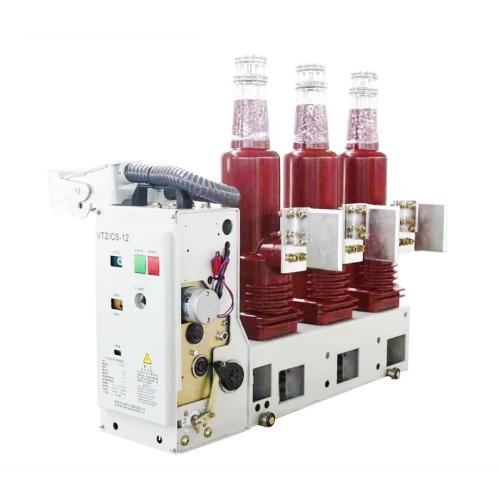

The withstand voltage standard for insulation across the open contact gap is higher than that for insulation to ground; this is a mandatory requirement under national standards, intended to prevent lightning strikes from bridging the contact gap when the switch is open, thereby averting serious incidents such as unintended closing. The specific comparison and underlying reasons are as follows:
The withstand voltage standards for insulation across the open contact gap and insulation to ground differ primarily because the operating conditions and the nature of the voltage stress they experience within the electrical equipment are different. A detailed explanation follows:
1. Operating conditions and voltage stress:
Insulation to ground: When the vacuum circuit breaker is in the closed position, insulation to ground is maintained by support insulators. If a permanent ground fault occurs on the line and the circuit breaker trips without the fault being cleared, the insulation to ground for the energized busbar must be withstood by the vacuum gap across the circuit breaker's open contacts.
Contact gap insulation: During the interruption of various faults, the vacuum insulation gap between the contacts must withstand various recovery voltages without undergoing dielectric breakdown.
2. Withstand voltage test standards:
Motor insulation standards: Motors have distinct standards for phase-to-phase and phase-to-ground insulation resistance. For instance, phase-to-phase insulation resistance is typically required to exceed 1 MΩ/km, whereas phase-to-ground insulation resistance must exceed 10 MΩ/km. Additionally, there are specific requirements regarding the dielectric loss tangent (tan δ) and voltage withstand tests.
Vacuum circuit breaker withstand voltage standards: The withstand voltage rating for the contact gap of a vacuum circuit breaker is generally tested at 75% or 80% of the factory test voltage; no flashover or breakdown across the contacts is permitted.
3. Test principles and applications:
Insulation testing: This method assesses equipment insulation status using high-voltage DC generated by an internal battery. Characterized by high output power, strong load-bearing capacity, and robust anti-interference capabilities, it is frequently used in the electric power industry and related sectors.
Withstand voltage testing: This involves applying a voltage higher than the normal operating voltage to the equipment under test and evaluating insulation performance by monitoring leakage current over a specified period. It is primarily used for testing equipment such as polyethylene-insulated power cables and large power transformers.
In summary, the withstand voltage standards for contact gap insulation and insulation to ground differ primarily because the operating conditions and voltage stress patterns within the electrical equipment vary; consequently, they require separate testing and evaluation.
Why must the withstand voltage across the open contacts be higher?
Concentrated exposure to lightning overvoltage: When a circuit breaker is open and out of service but the line side remains energized (e.g., during equipment maintenance or hot standby), a lightning strike on the line side can generate an incoming overvoltage, while the power-supply side remains at the system voltage. Consequently, the full voltage difference between the line and the power source is applied directly across the gap between the open contacts.
Prevention of catastrophic accidental conduction: Because the contact gap must withstand immense voltage differences and overvoltage surges, if its insulation level is lower than or equal to the insulation level to ground, it is highly susceptible to dielectric breakdown during a lightning strike. Such a breakdown could lead to accidental closing of the switch, an energized line faulting to ground, or equipment explosion. Therefore, the insulation level across the open contacts must be increased to ensure safety while the breaker is in the open position.
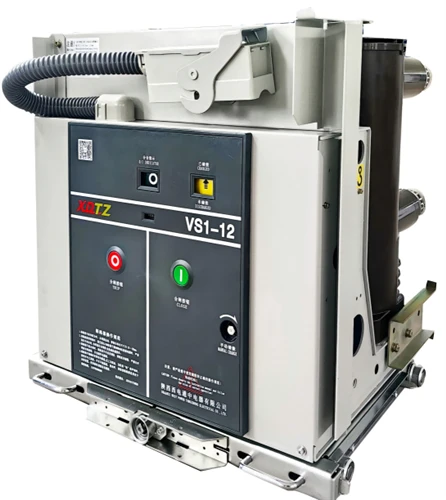
If you are interested in VS1-12 vacuum circuit breaker, please contact us at any time.

Reliable Vacuum Circuit Breakers, Customized for Global Clients
Professional Technical&Sales Team | On-Time Delivery
12KV/24KV/40.5KV vacuum circuit breakers
Shaanxi West Power Tongzhong Electrical Co., Ltd.
Our address
No.1 East Gaoxin Avenue, High-tech Development Zone, Baoji City, Shaanxi Province, China
Phone Number
+86 18091767067(WhatsApp/Wechat/Telegram)